Crossover tuning
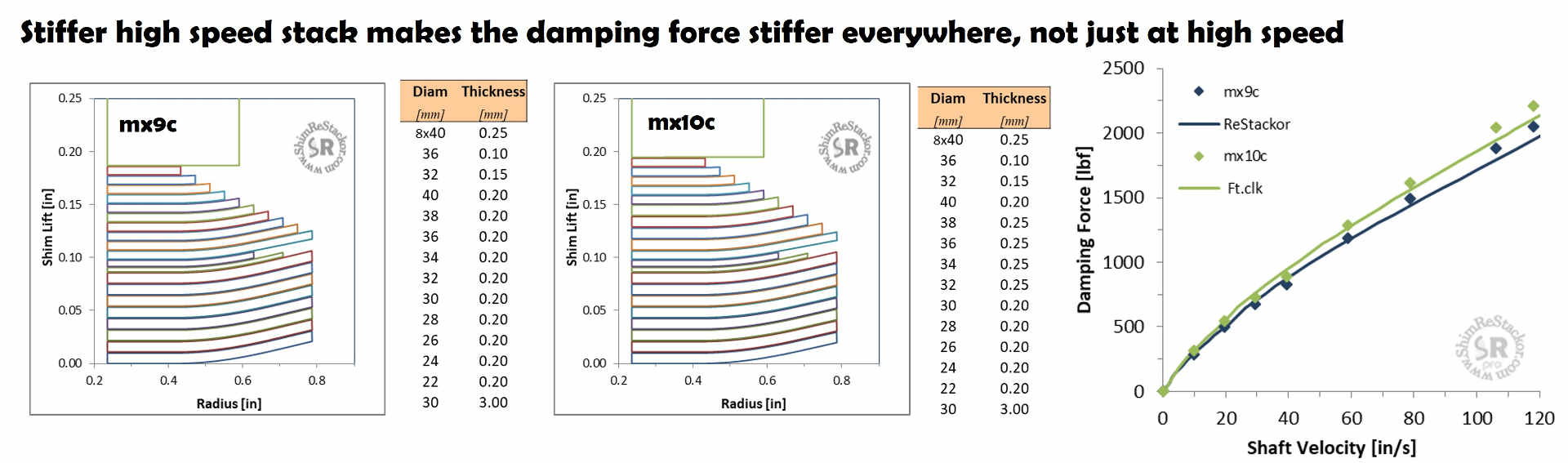
Valving Logic demonstrated the effect of adding a crossover to a simple tapered shim stack. Adding the crossover makes the damping force softer everywhere, not just at low speed.
Tuning crossovers to produce the single effect of softer low speed damping requires multiple changes to the shim stack:
- Adjust the crossover position
- Adjust the crossover diameter to produce the desired low speed damping
- Adjust crossover gap to produce the desired closure velocity
- Adjust the high speed stack to produce the desired high speed damping
There is no algebraic equation to “design” a crossover. Crossovers are tuned by hacking around on each of the above four parameters to hit the desired ow damping target while maintain the same high speed damping. That is a tedious process on a dyno, but rapid Shim ReStackor calculations make the process easy.
Tuning crossovers to hit a damping target requires multiple simultaneous changes to obtain the single result of softer low speed damping. Multiple simultaneous changes frustrates many tuners committed to the “one thing at a time” approach to tuning.
Interactive crossover rm85
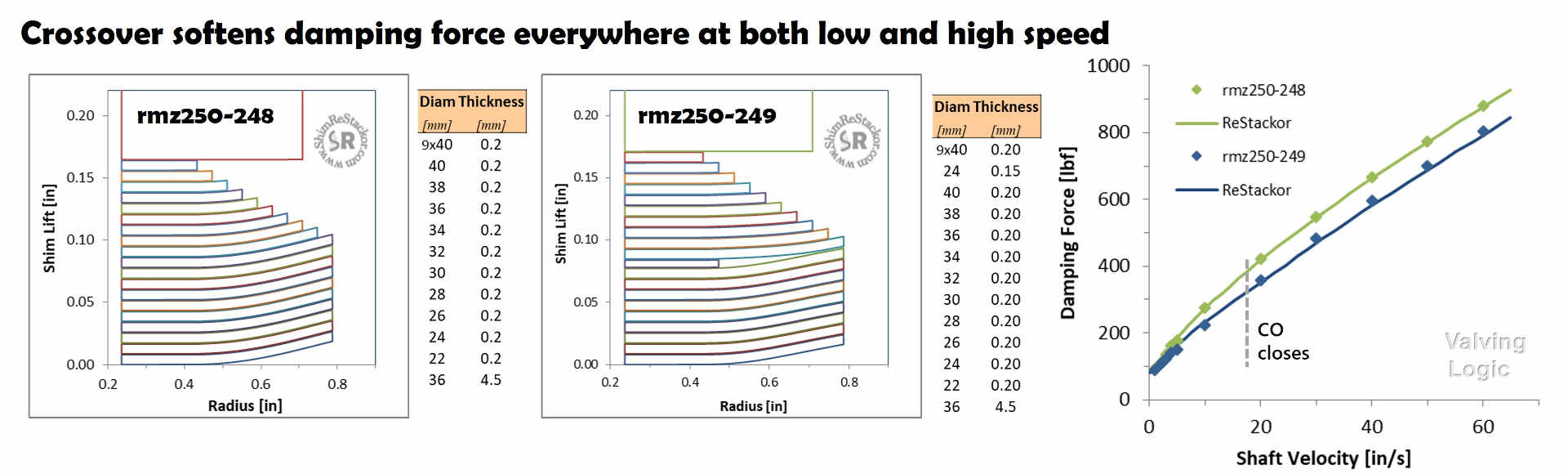
Interactive crossovers use a shim diameter that is larger than the shim stack clamp. The larger crossover diameter transfers force from the face shims directly into the high speed stack forcing the high speed stack to deflect before the crossover closes. Interaction with the high speed stack softens the crossover closure event (linky sample apps).
Valving Logic on Thumper Talk demonstrated the performance of an interactive crossover. The damping force data shows no evidence of the crossover closing. However, Shim ReStackor calculations of the shim stack deflection and stack flow area make it easy to spot the crossover closure velocity at 20 in/sec.
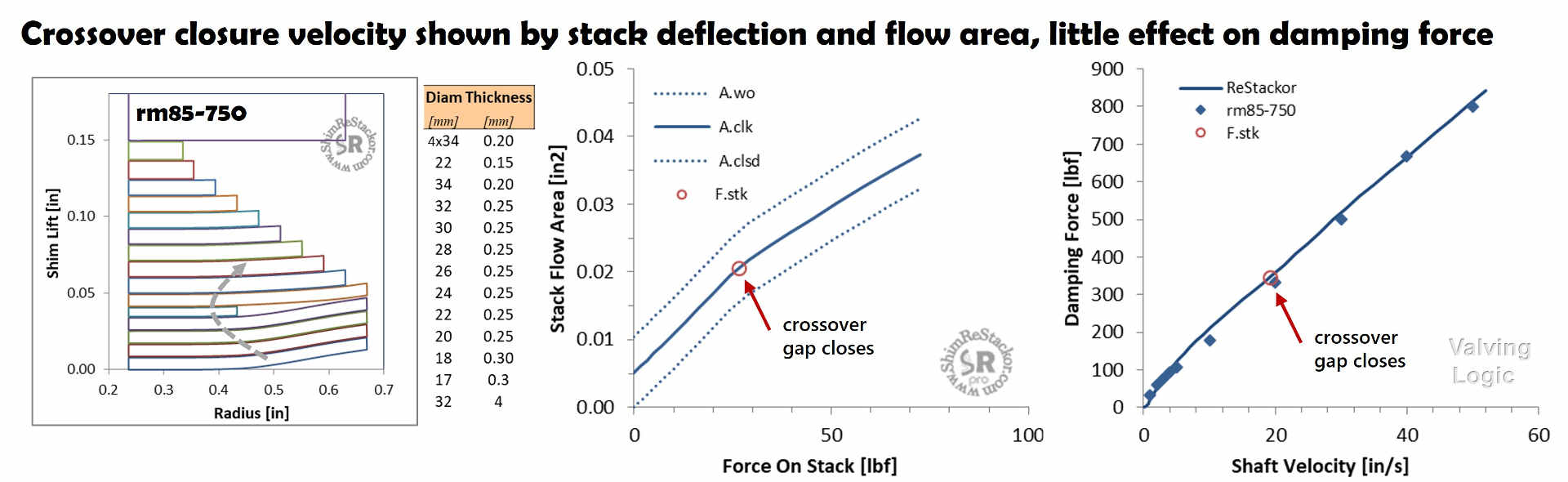
Soft closures of interactive crossover with a soft high speed stack often do not produce any specific “event” in the damping force curve. The data at 20 in/sec where the crossover closes shows that.
MXScandinavia interactive crossover
Interactive crossovers (linky sample apps) use a shim diameter that is larger than the shim stack clamp. The larger crossover diameter transfers force from the face shims directly into the high speed stack forcing the high speed stack to deflect before the crossover closes. Interaction with the high speed stack softens the crossover closure event.
MXScandinavia dyno tests on Thumper Talk evaluated the performance of an interactive crossover configuration.
Shim ReStackor analysis of the configuration shows the crossover closes at a shaft velocity of 26 in/sec. Due to the shim stack configuration there is virtually no change in stack stiffness or damping force at the crossover closure confirming the dyno test results.
High speed damping (mx9c)
Softening or stiffening the high speed stack changes the damping force everywhere, not just at high speed.
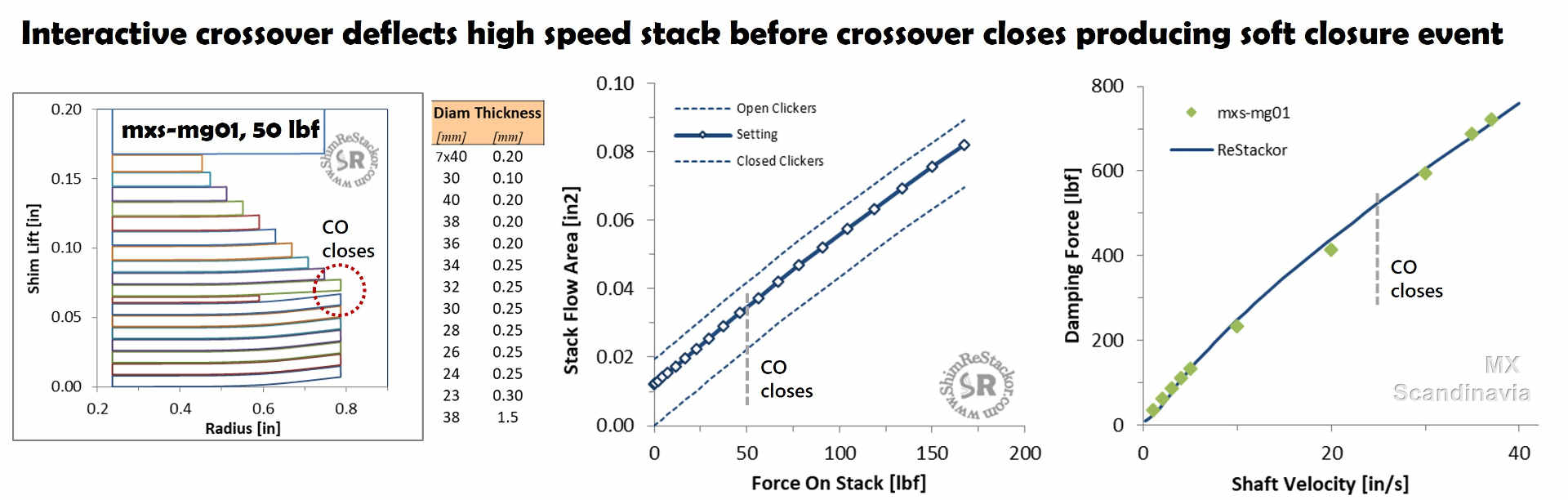
The example below from the MXScandinavia thread on Thumper Talk replaces the 0.2 mm shims in the stack taper with stiffer 0.25 mm shims.
The dyno test results (data points) show the shim stack is stiffer everywhere across the speed range, not just at high speed. Shim ReStackor calculations (shown by the lines) shows the same thing. High speed damping can be stiffened by tuning the crossover or softened using a preloading ring-shim (linky, fundamentals).