
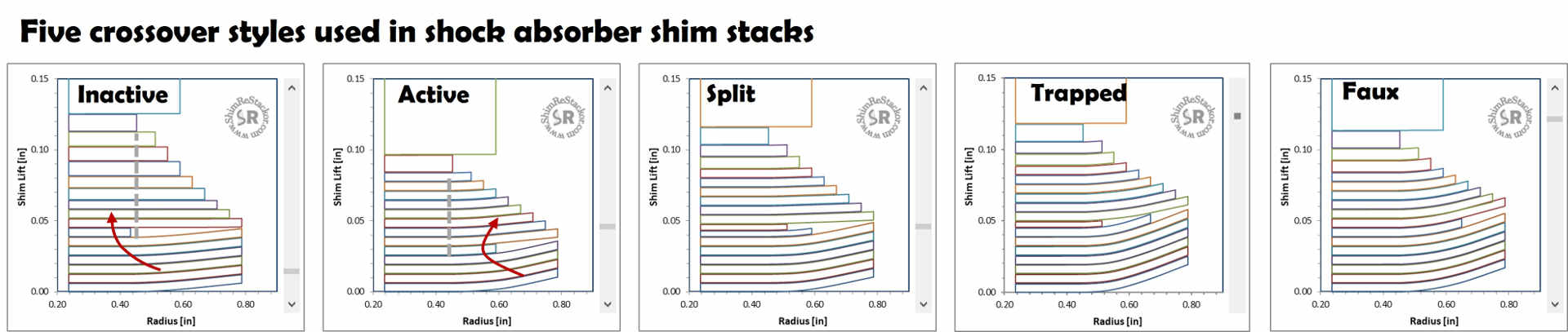
A crossover splits the shim stack into a high and low speed stack. Shims below the crossover form the low speed stack. Shims above form the high speed stack and do not fully engage until the crossover gap closes. There are five different styles of crossovers.
- CO diameter: Increasing the crossover diameter increases the damping force and progressively shifts the damping curve shape from progressive through linear to digressive
- CO position: Moving the crossover up increaes damping force and delays closure of the crossover gap
Crossovers soften low speed damping which shifts the basic digressive curve shape of a simple tapered shim stack (linky to sec 3.1) into a linear or progressive damping force curve. There are five different styles of crossovers.
- CO gap: Increasing
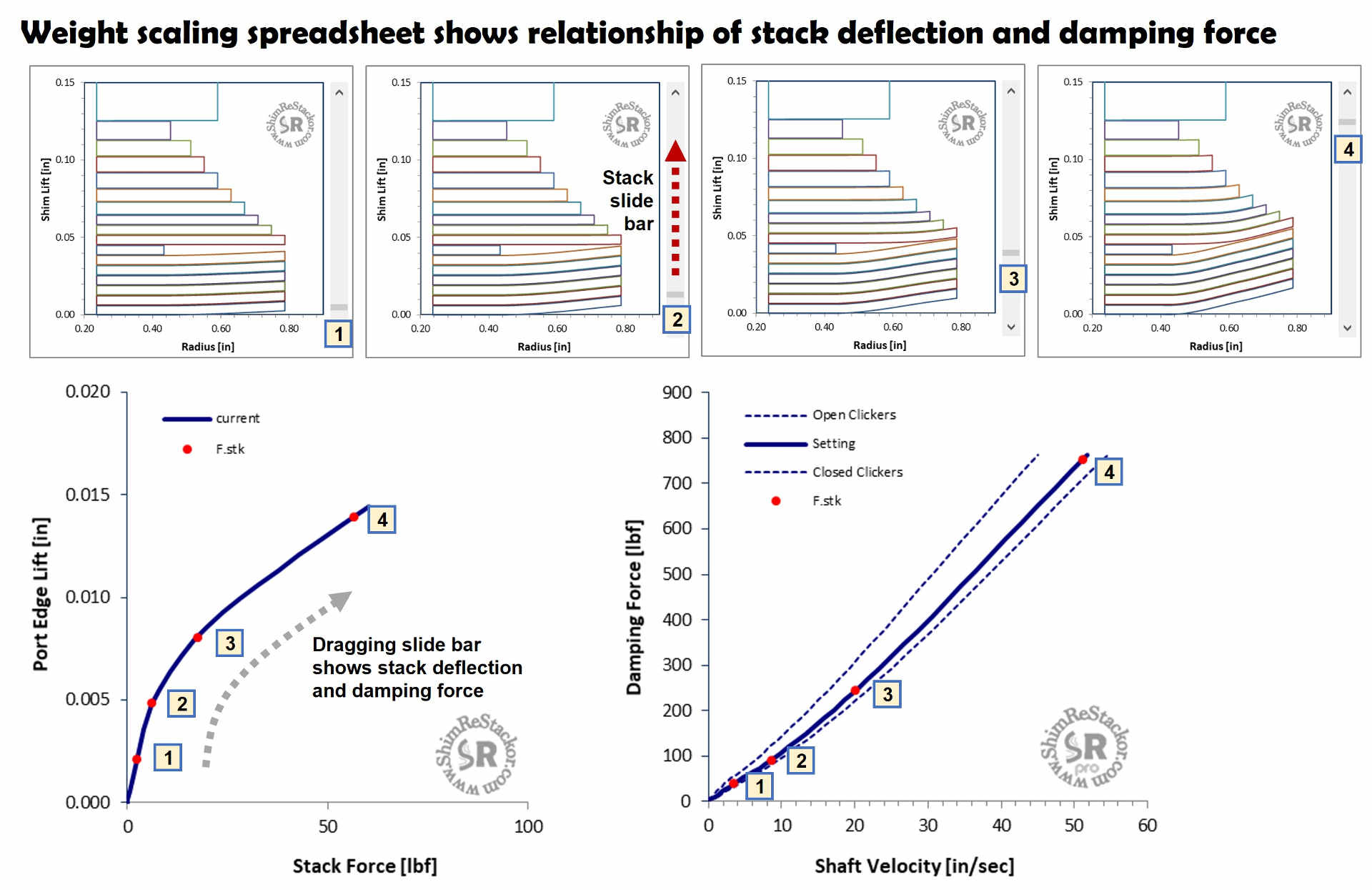
Shim ReStackor weight scaling spreadsheet
The Shim ReStackor weight scaling spreadsheet includes a slide bar on the shim stack graphic. Dragging the slide bar pans the shim stack through the deflection range and simultaneously positions red symbols on each plot indicating the value at that shim stack deflection position.
The slide bar is useful for tunning crossovers and spotting the shaft velocity where the crossover gap initially closes and tracking the damping force change as the high speed stack progressively engages at higher shaft velocities. The slide bar is also useful in understanding the operation of a trapped crossover or determining the crossover shim diameter whare the operation shifts from an active crossover to a faux gap.
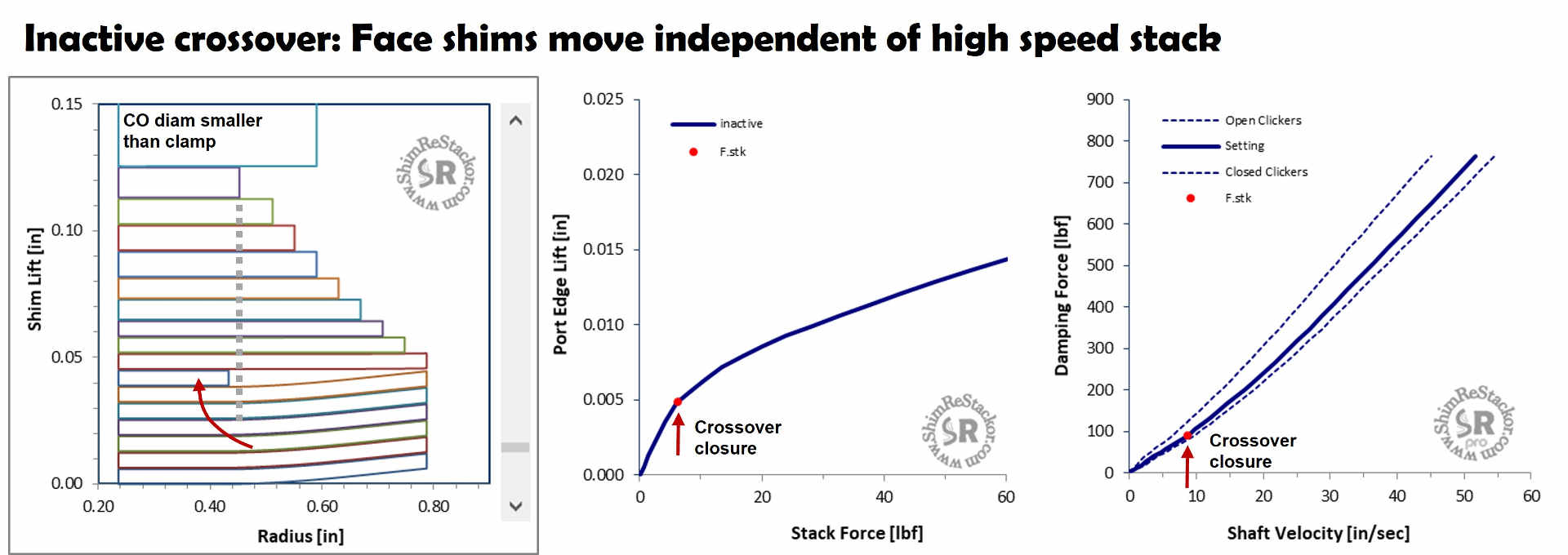
Inactive crossover
An inactive crossover has a shim diameter that is smaller than the stack clamp. At low speed, before the crossover closes, the forces applied to the face shim deflect the low speed stack and do not produce any deflection of the high speed stack.
After the crossover closes, the high speed stack supports the outside edge of the low speed stack giving an increased shim stack stiffness and damping force. The increase in stack stiffness at crossover closure results in a progressive damping force curve.
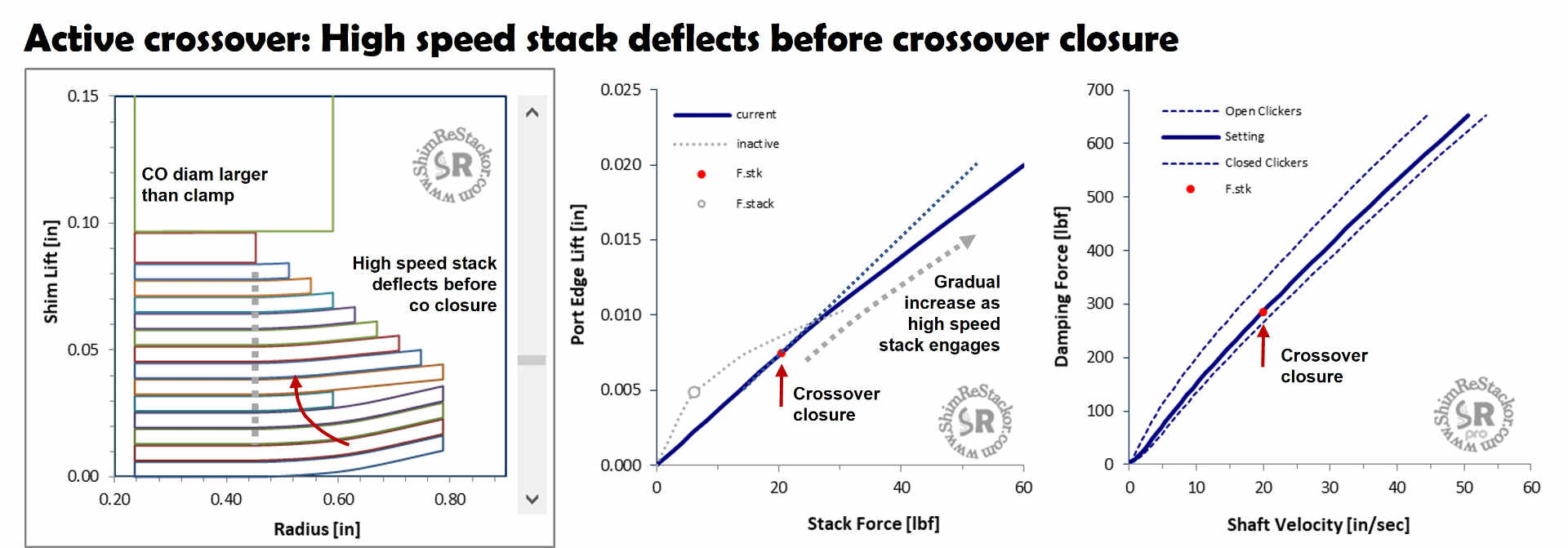
Active crossover
An active crossover uses a shim diameter that is larger than the stack clamp. The larger diameter transfers force from the low speed stack into the high speed stack before the crossover gap closes. The force transfer softens the crossover closure event producing a smoother damping force curve.
On an active crossover stiffening the high speed stack stiffens both low speed and high speed damping. The interaction can make it hard to guess the changes needed to get a specific result.
Split crossover
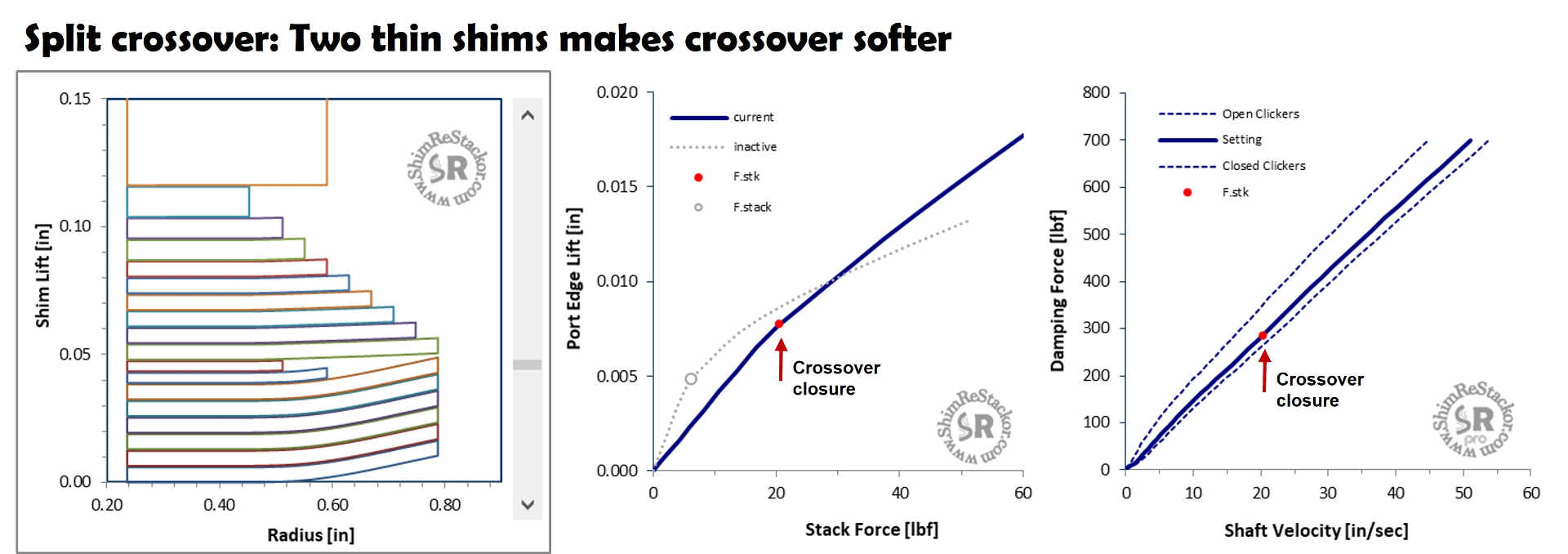
A split crossover uses two shims to form the crossover gap. Split shims smooth the bend at the crossover shoulder helping to prevent kinking of the face shims on the sharp corner of a single crossover shim.
By the thickness cubed rule, one 0.2 mm shim is equivalent to eight 0.1 mm shims. Replacing a 0.2 mm crossover with a pair of 0.1 mm shims adds less stiffness to the shim stack.
Trapped crossover
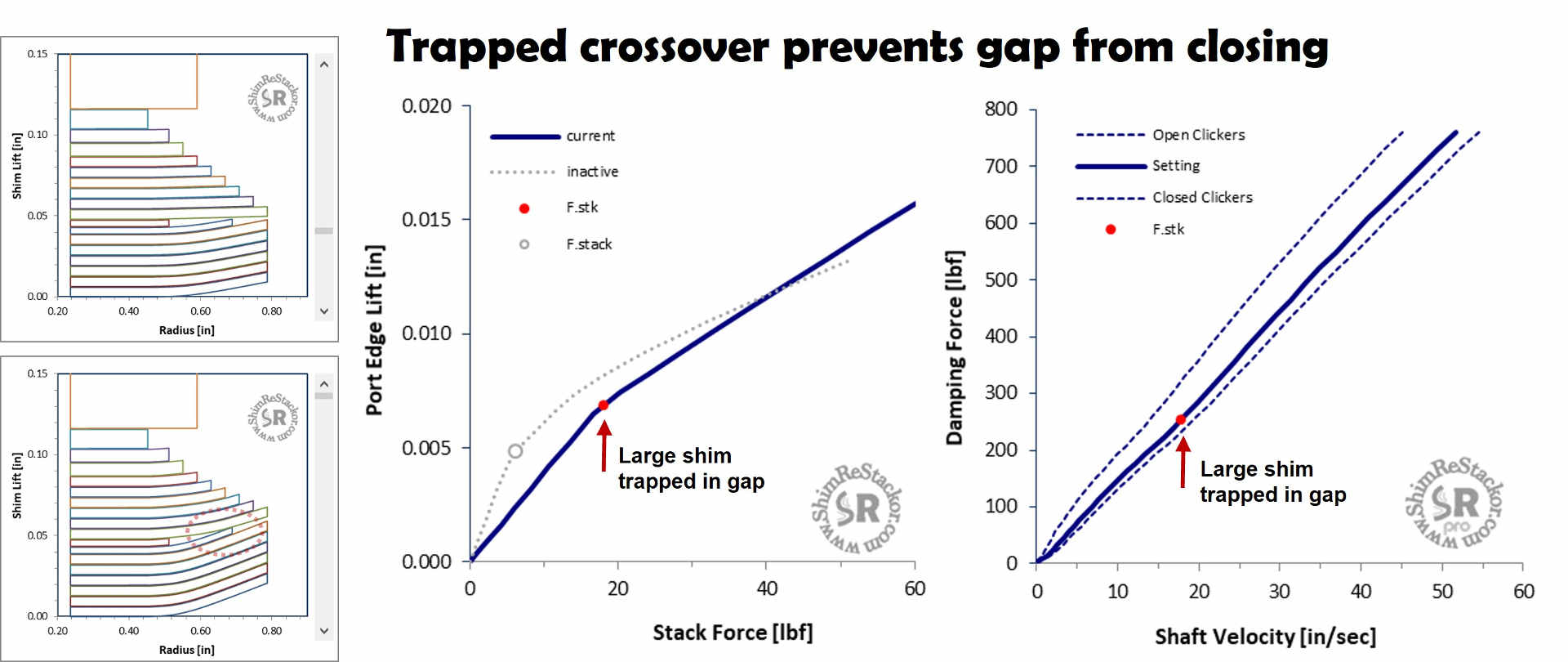
A trapped crossover is a split shim crossover where the larger diameter shim becomes trapped in the closing crossover gap. The trapped shim transfers force into the high speed stack before the crossover gap closes resulting in a shim stack the is stiffer than expected. MXScandinavia provides a dyno test example of the unexpected stiffness increase created by a trapped crossover.
Shim ReStackor stack deflection calculations show when a crossover shim becomes trapped in the crossover gap which helps to avoid the unexpected damping force increase of a trapped crossover configuration.
Faux crossover
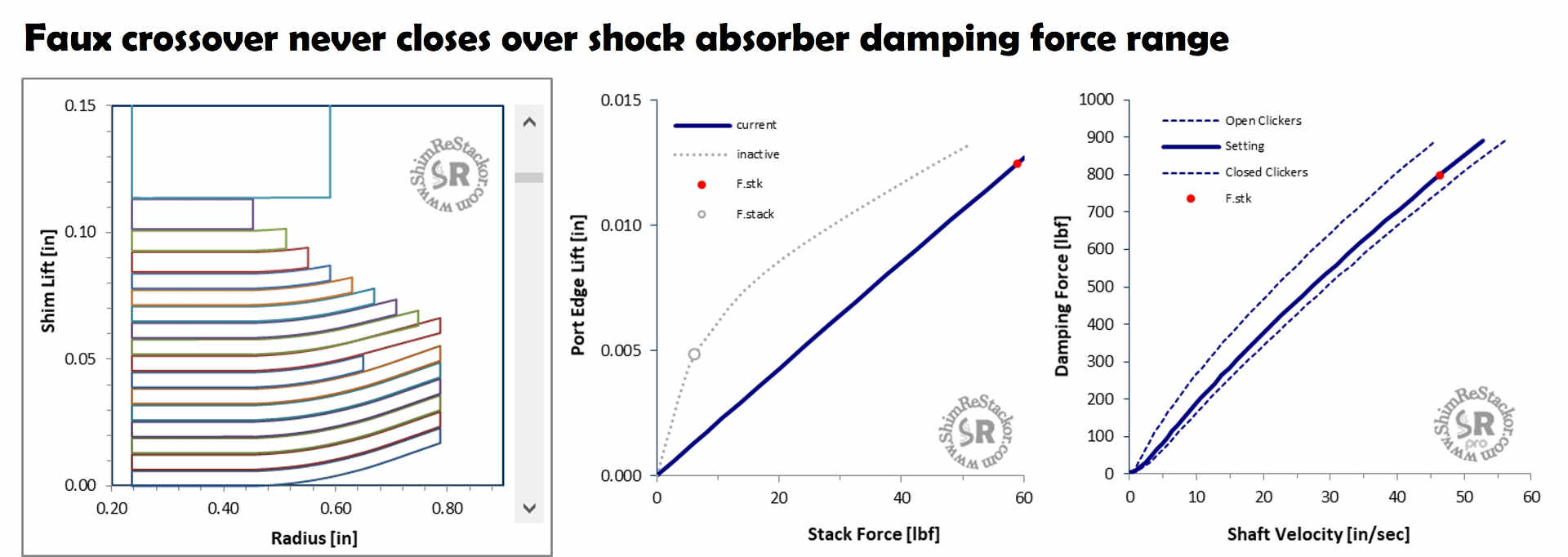
Faux crossovers deflect the high speed stack at the same rate as the face shims. Faux crossover gaps never close.
Faux crossovers are caused by large diameter crossover shims, soft high speed stacks that are not stiff enough to crush the crossover gap, or valve port geometries that produce little force at the outside edge of the face shim. Shim ReStackor calculations are capable of determining all of those conditions.
Crossover parameters
Installing a crossover requires a large number of decisions: the crossover diameter, position, gap and high speed stack stiffness.
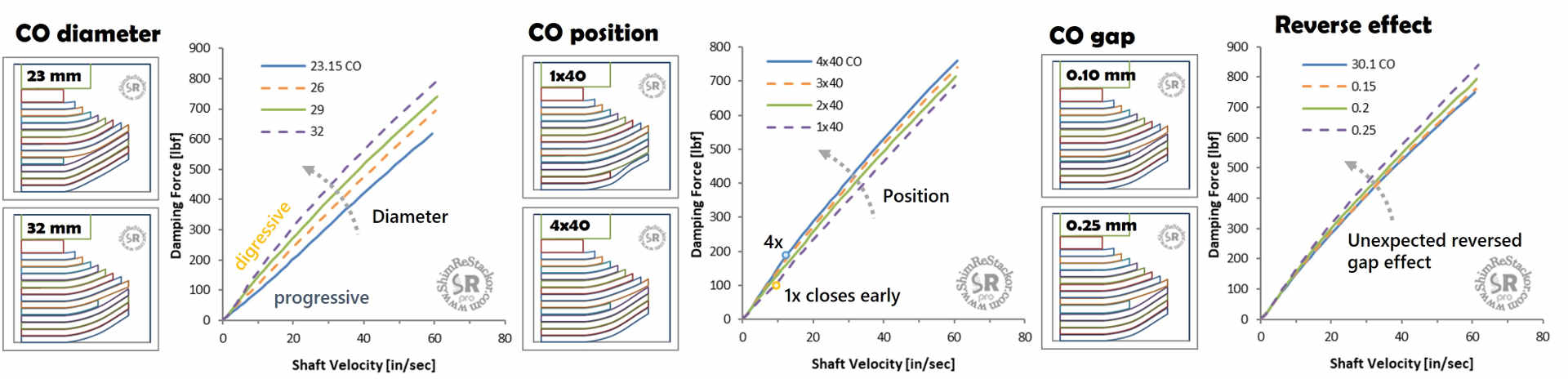
- CO diameter: Increasing the crossover diameter increases damping force and progressively shifts the damping curve shape from progressive through linear to digressive
- CO position: Moving the crossover up increases damping force and delays closure of the crossover gap
- CO gap: Increasing the crossover gap softens damping and delays crossover gap closure. However, the example below demonstrates the reverse effect. Installing a thicker crossover shim increased the stiffness of the low speed stack and resulting damping force compared to configurations using a thinner crossover shim. The example demonstrates there are exceptions to what often seem like obvious shim stack tuning rules
There is no secret formula to figure out the specific combination of parameters needed to hit a specific damping force target. Crossover configurations are tuned by progressively hacking the crossover gap height, diameter, number of face shim and high speed stack stiffness until the combination of parameters is found that deliver the desired damping force curve.
The capability of Shim ReStackor to show how the shim stack deflects, the velocity where crossover gaps close and the influence of the high speed stack on damping force makes tuning of crossover shim stacks simple, easy and intuitive.