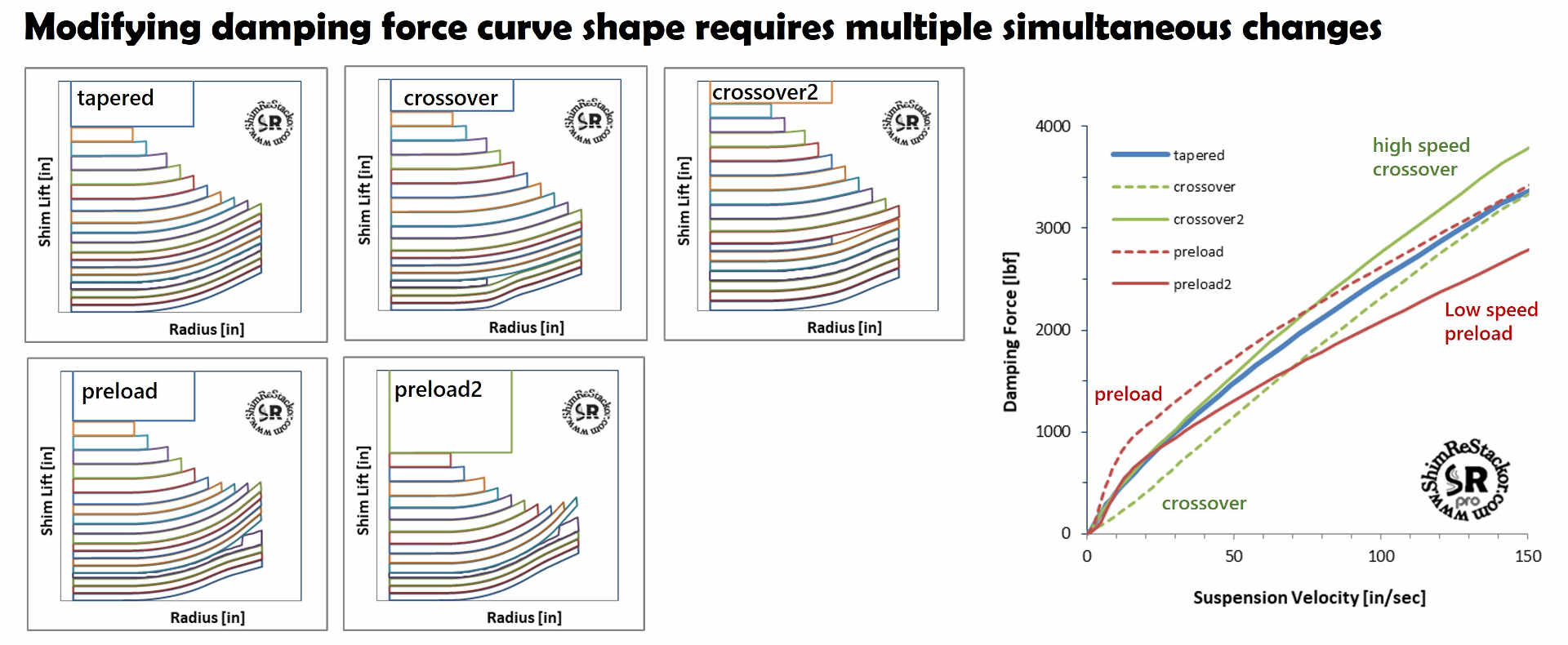
A simple tapered shim stack produces a digressive damping force curve. Digressive means damping force falls-off at high speed in comparison to a constant slope linear curve.
Changing the shape of the damping force curve requires adding a crossover or ring shim to modify the force versus lift profile of the shim stack.
Shim stack crossover
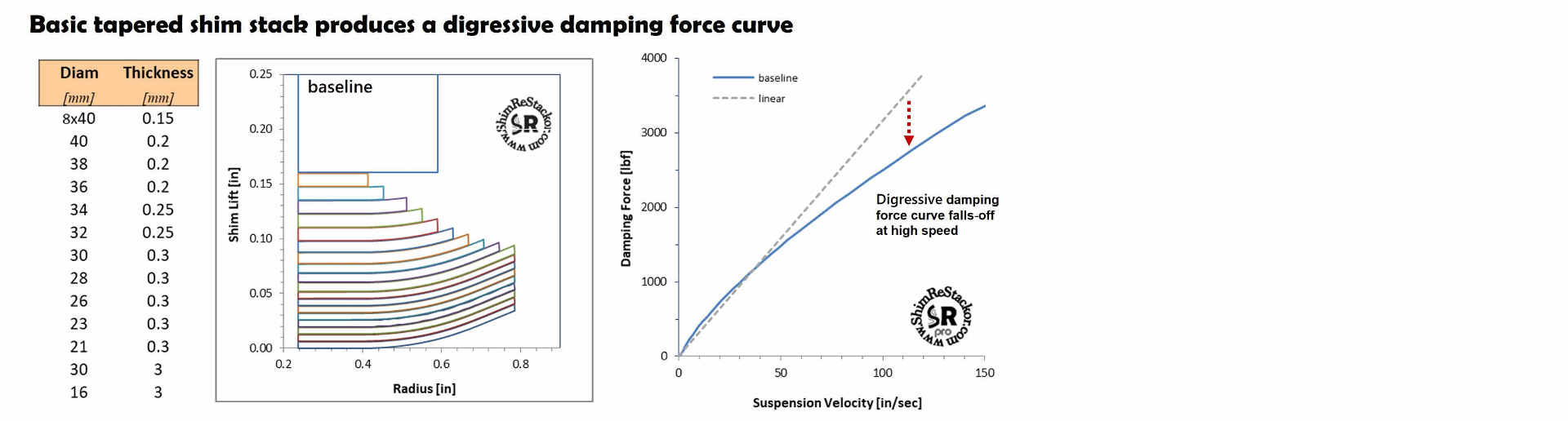
Crossovers create a gap in the shim stack allowing the face shims to deflect independently of the high speed stack. The gap allows the face shims to crack open at low speed with less force on the shim stack. Softer low speed damping with the crossover makes the damping force curve “look” more linear.
Changing the crossover position and/or diameter shifts the damping force curve from digressive to linear or progressive. Rebound shim stacks often use a crossover to produce a near linear damping force curve.
Shim stack preload
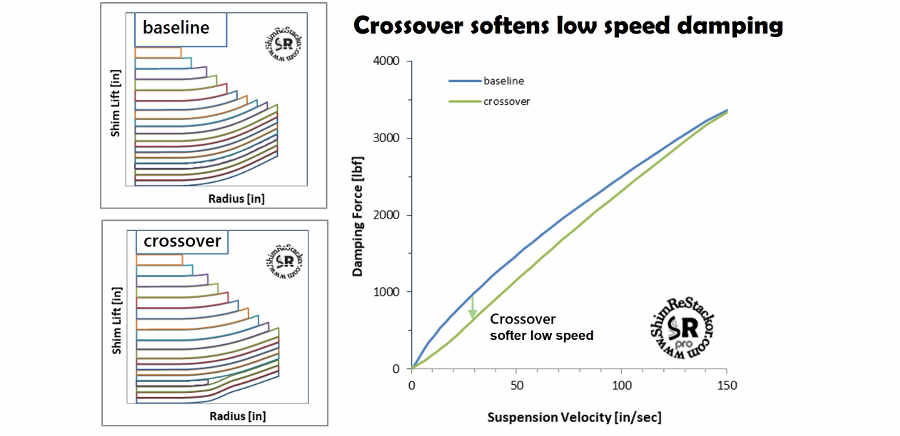
Ring shims preload the face shims against the valve face. Preload holds the shim stack closed at low speed which increases low speed damping.
When the shim stack cracks open, damping force drops-off making the damping force curve look more digressive compared to a simple tapered shim stack.
Stiffer high speed damping
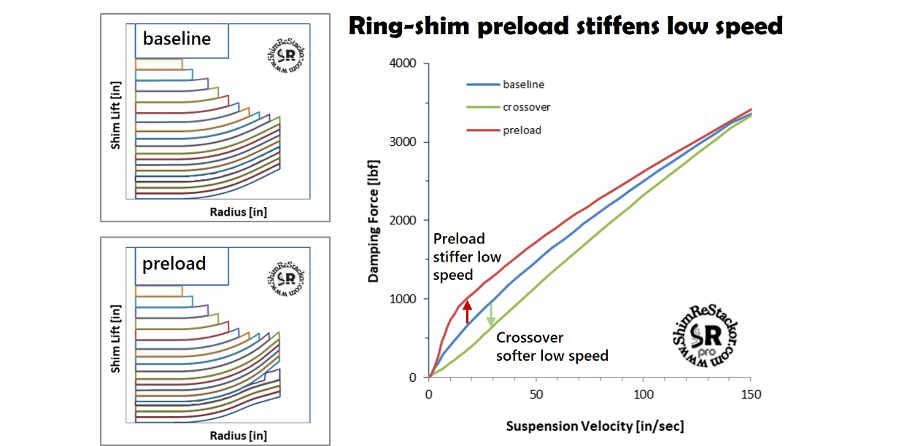
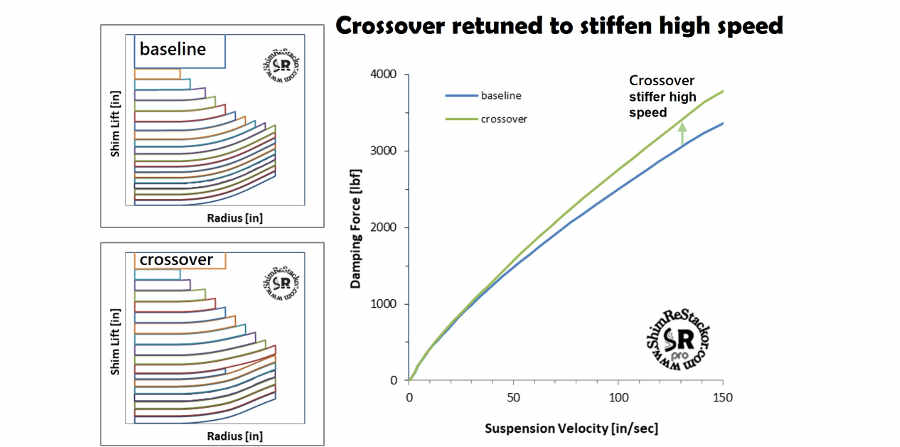
Crossovers can be tuned the other way around. Instead of making low speed damping softer the high speed shim stack can be stiffened to make high speed damping stiffer.
The example below uses a stiffer low speed stack to keep low speed damping the same. After the crossover closes, the high speed stack kicks in making damping stiffer at high speed.
Softer high speed damping
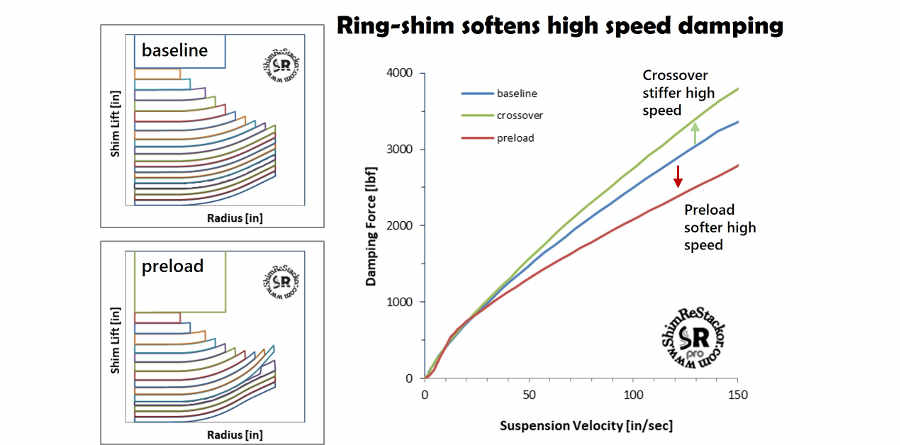
Ring-shims can also be tuned the other way around. Instead of making low speed damping stiffer a ring shim can be used to make high speed damping softer.
The example removes face shims to soften the shim stack and adds a ring shim to stiffen low speed. The resulting curve matches the low speed damping of the original stack and provides softer high speed damping.
Shim ReStackor introduces a new era in suspension tuning
Modifying shim stacks to make the overall damping softer or stiffer is pretty simple. Adding shims makes the damping stiffer, removing shims makes it softer.
Changing the shape of the damping force curve is more challenging. A simple tapered shim stack produces a digressive damping force curve. Adding a crossover makes low speed damping softer but also softens high speed damping. Obtaining the single effect of softer low speed with the same high speed damping requires stiffening the high speed stack when adding the crossover. Controlling the damping force curve shape requires multiple simultaneous changes to obtain the single effect of softer low speed damping. Guessing the combination need is dificult, a skill professional tuners spend years developing.
Figuring out the combination of shim stack changes needed is easy with Shim ReStackor. The calculations show damping force across the entire range of suspension velocities. Perfecting low speed, mid-speed and high speed simply requires hacking around on the shim stack, adding or removing shims, crossovers or stack preload until the desired damping force target is achieved.
The capability to see how the shim stack deflects and the effect each modification has on the damping force curve makes tuning with Shim ReStackor simple, easy and intuitive.