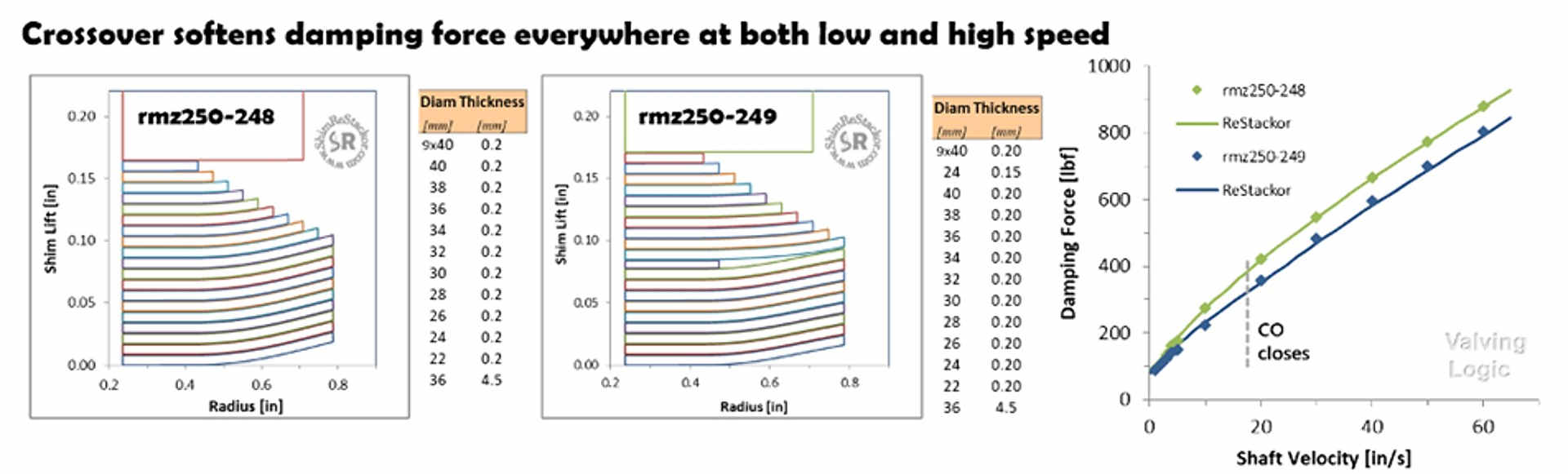
Valving Logic dyno tested a simple tapered shim stack with and without a crossover on ThumperTalk. The crossover makes the damping force softer everywhere, not just at low speed.
Using a crossover to obtain softer low speed damping with the same high speed requires multiple simultaneous changes:
- Adjust the crossover position and diameter to produce the desired low speed damping
- Une crossover gap to produce the desired closure velocity
- Adjust the high speed stack to produce the desired high speed damping
Changes to the high speed stack effects low speed and changes to low speed stack effects high speed. Thus, tuning crossovers is interactive and the usual approach of changing one thing at a time does not work. Instead, the above combination of parameters is changed until a shim stack configuration is found that meets both low-speed and high-speed damping requirements at the same time.
Faux crossover gaps
A faux crossover gap never closes and keeps the same edge gap over the range of shim stack deflections. Faux gaps are created by large diameter crossover shims, stiff low speed stacks or soft high speed stacks that cannot produce enough resistance to force closure of the crossover gap.
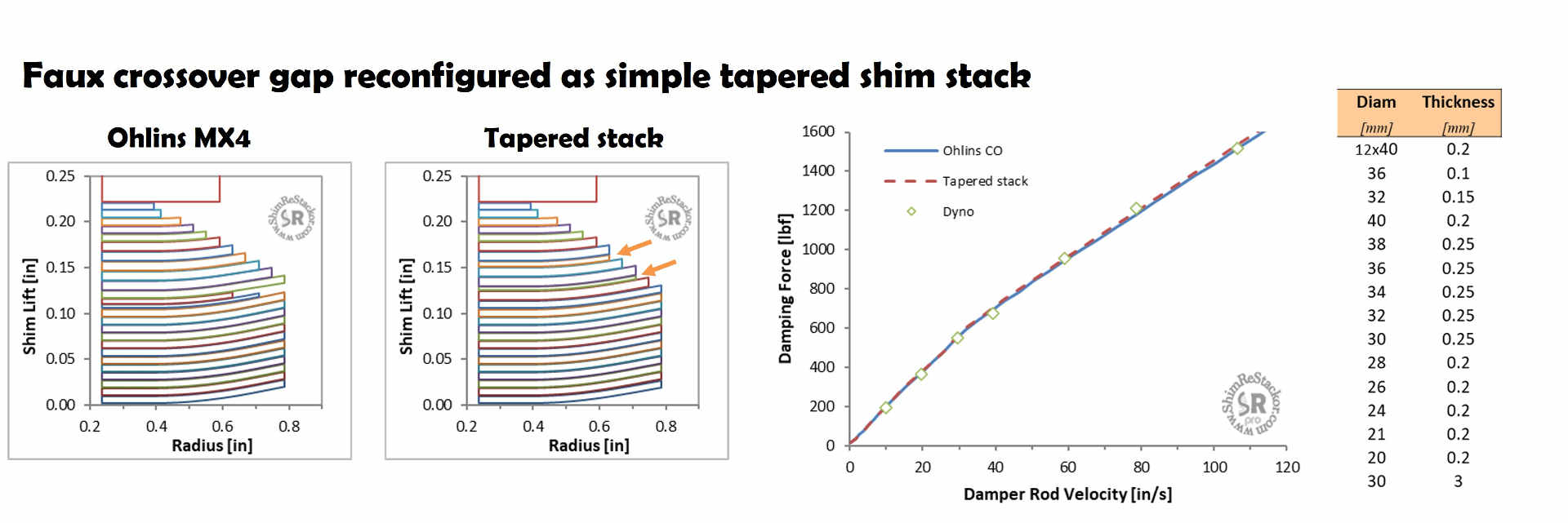
The Ohlins MX4 shim stack below is an example of a faux crossover. The pair of shims forming the crossover can be repositioned into the stack taper forming a simple tapered shim stack with the same damping force confirming the crossover gap is faux.
The Ohlins MX4 shim stack below is an example of a faux crossover. The pair of shims forming the crossover can be repositioned into the stack taper forming a simple tapered shim stack with the same damping force confirming the crossover gap is faux.
Faux crossovers create problems for dyno tuners. Modifications to the shim stack can cause the faux gap to suddenly become active resulting in a large drop in damping force. Shim stack changes causing the faux gap to suddenly become active or inactive are not always obvious.
Trapped crossover
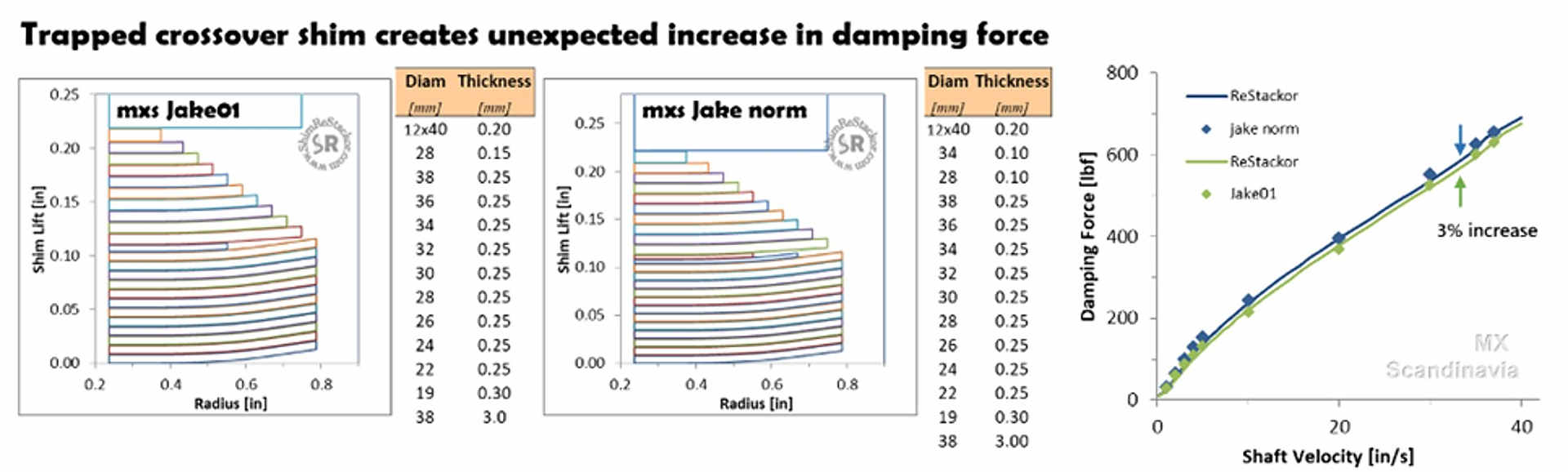
MXScandinavia on Thumper Talk compared the damping performance of crossover shim stack configurations. The two shim stacks below are identical with the single difference of replacing the crossover with a 34x0.11/28x0.1 split shim pair.
By the shim factor thickness cubed rule (shim fac), the replacement shim pair should be 40% softer than the single 28x0.15 crossover shim. In addition, the split shim pair forms a larger 0.2 mm crossover gap compared to 0.15 for the single shim. The split shim pair is 40% softer shims with a larger crossover gap which should result in less damping force for the split shim pair.
However, dyno testing shows the opposite. The split shim configuration generates 3% more damping force. The reason for the difference is the larger 34x0.1 crossover shim becomes trapped in the closing crossover gap reducing the “effective” crossover gap to 0.1 mm instead of the expected 0.2 mm gap.
Shim ReStackor calculations closely follow the dyno data confirming the 34x0.1 crossover shim becomes trapped in the closing crossover gap making the theoretically softer shim stack stiffer than the single shim crossover.
Crossover shim stack tuning
There are no algebraic relationships that can be used to design a crossover. Instead, crossover shim stacks are progressively refined through changes to the low speed and high speed stack stiffness along with the crossover shim diameter and thickness. The process is tedious.
Shim ReStackor significantly simplifies the crossover tuning process. Calculations take a couple of seconds so dozens of shim stack configurations can be tested in a couple of minutes progressively refining low and high speed damping to hit the desired targets. In addition, the shim stack deflection graphic shows how the shim stack deflects allowing unusual configurations like faux crossover gaps and trapped crossover shims to be easily identified.