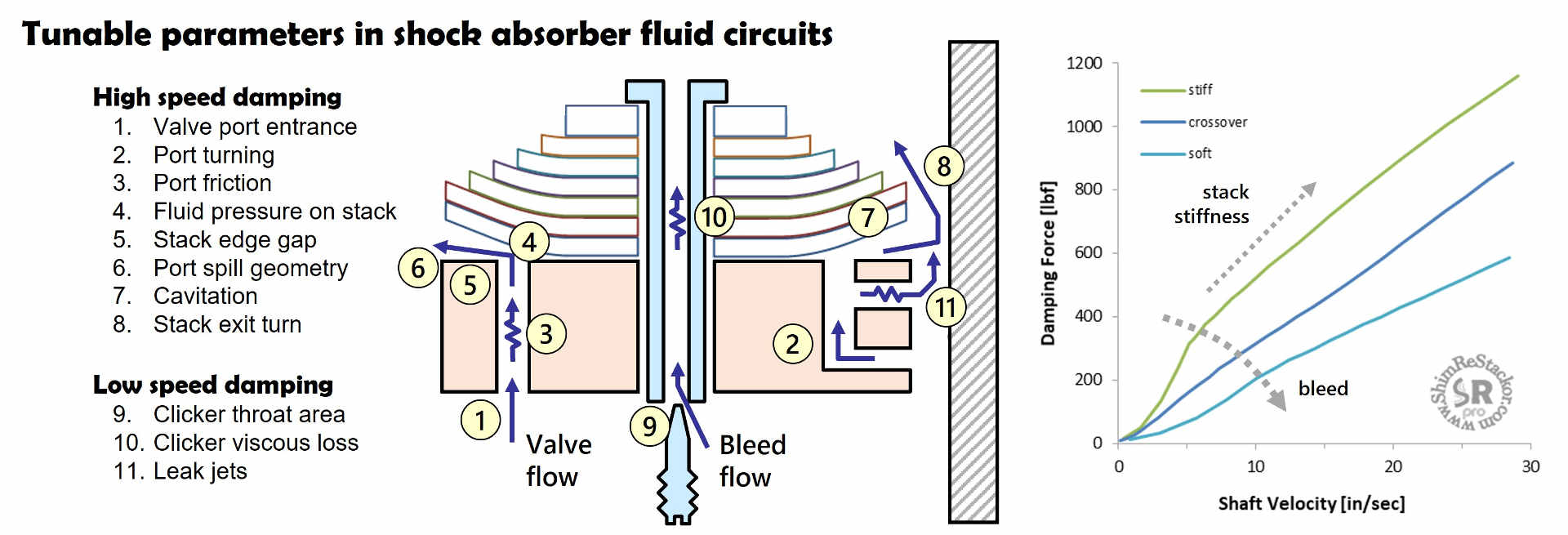
Shim ReStackor models eleven tunable features of shock absorber circuits. Bleed systems control low speed damping. Flow restrictions control high speed damping and the suspension bottoming resistance.
Tuning leak jets and valve port throat restrictions gives additional control of the damping force beyond the fundamentals of shim stack tuning (linky flow resistance).
Compression adjuster flow rate
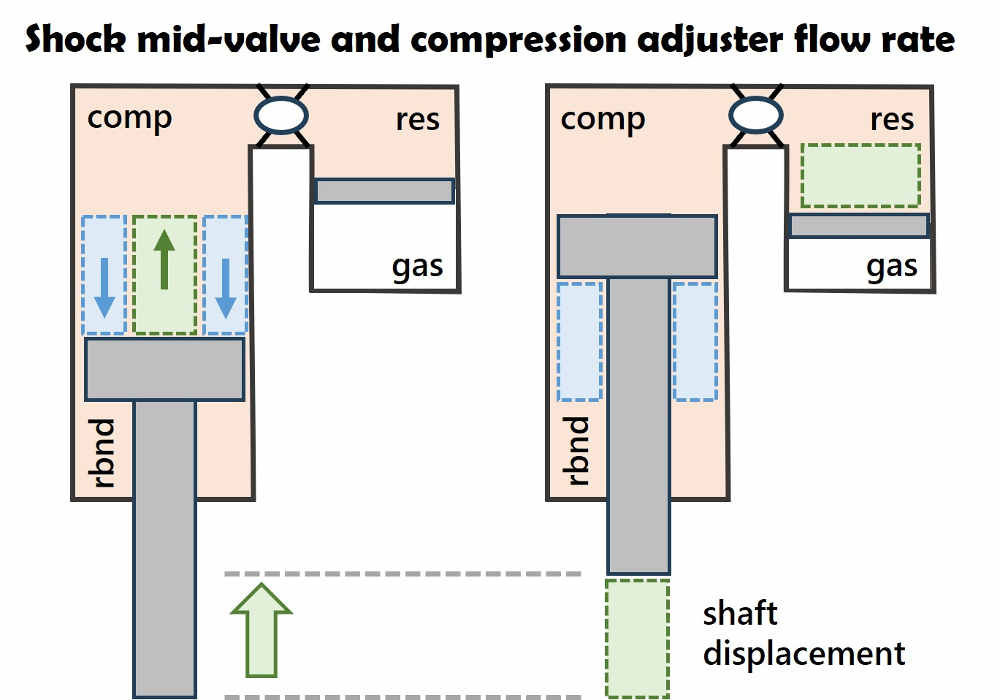
Driving the shock shaft into the shock body pushes an equal volume of fluid out of the shock through the compression adjuster into the oil reservoir. Thus, the shock shaft diameter sets the flow rate through the shock compression adjuster and the base valve on a fork. (linky flow rate).
Mid-valve flow rate
The mid-valve sweep area is defined as the piston face area minus the shaft area. As the piston is driven into the shock the oil volume swept by the mid-valve is forced through the mid-valve into the rebound chamber (linky flow rate).
Shock absorber valve geometry
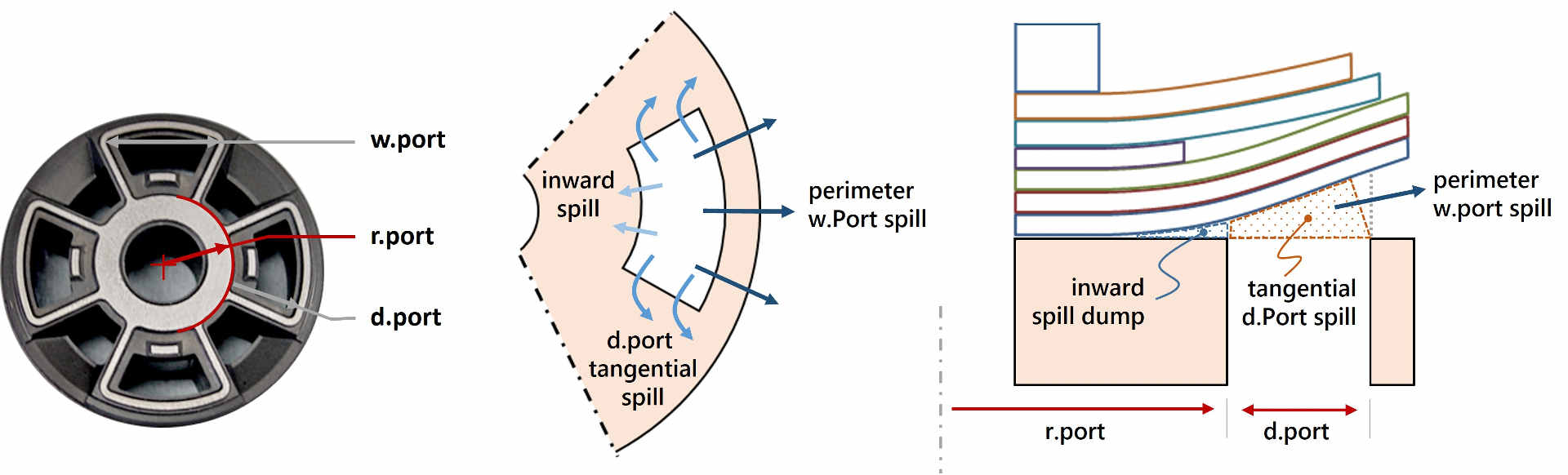
Three parameters define the Shim ReStackor valve port geometry:
- r.port: Inside port radius where fluid pressure is applied to the shim stack face
- d.port: Valve port spoke length controlling the fluid tangential side spill
- w.port: Valve port perimeter seat length controlling the radial perimeter spill
The three parameters r.port, d.port, and w.port define the valve port perimeter seat length metering flow out of the valve port. allowing Shim ReStackor calculations to integrate over the curved shim stack face shim surface to determine flow area and pressure drop across each valve in the shock absorber (linky valve port).
Shock oil properties
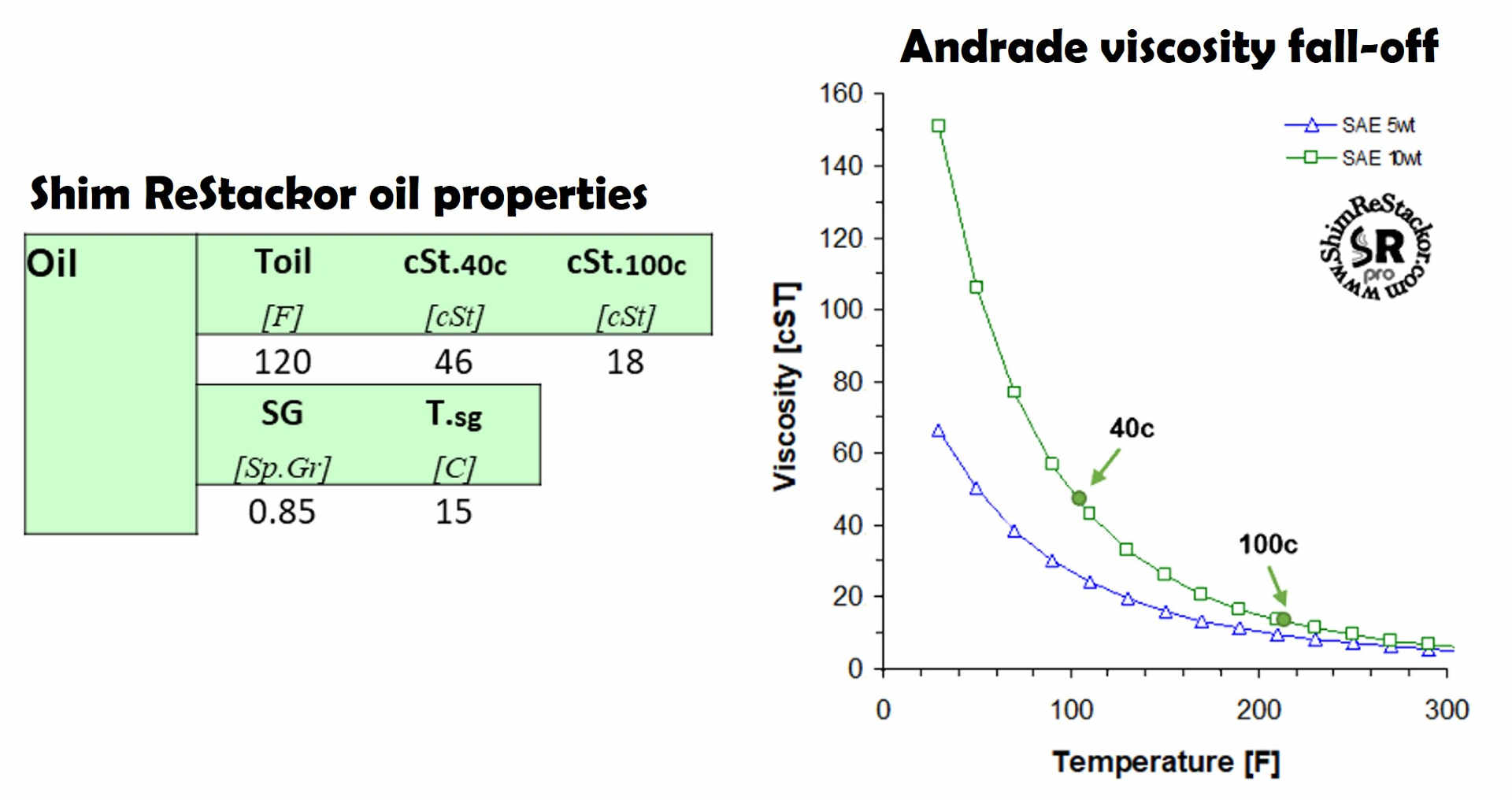
Inputs of kinematic viscosity (cSt) at two temperatures and the fluid specific gravity define the suspension oil properties. Oil density, specified as specific gravity, directly impacts shock absorber damping force over the entire range of suspension velocity.
Shim ReStackor uses the Andrade equation to determine the viscosity falloff at high temperature, speed of sound measurements to determine oil compressibility and Ostwald coefficients to define dissolved gas cavitation an oil foaming. (linky phys viscosity).
Shock absorber fluid dynamics
Multiple fluid circuits control the damping performance of shock absorbers. Valve port geometry, shim stack configuration, oil density, viscosity, temperature, bleed systems and cavitation suppression using back pressure devices all play a role. However, accurate fluid dynamic analysis is not enough to define shock absorber performance.
Performance also depends on the shim stack stiffness and deflection requiring FEA structural analysis to define the shim stack deflection and the flow area.
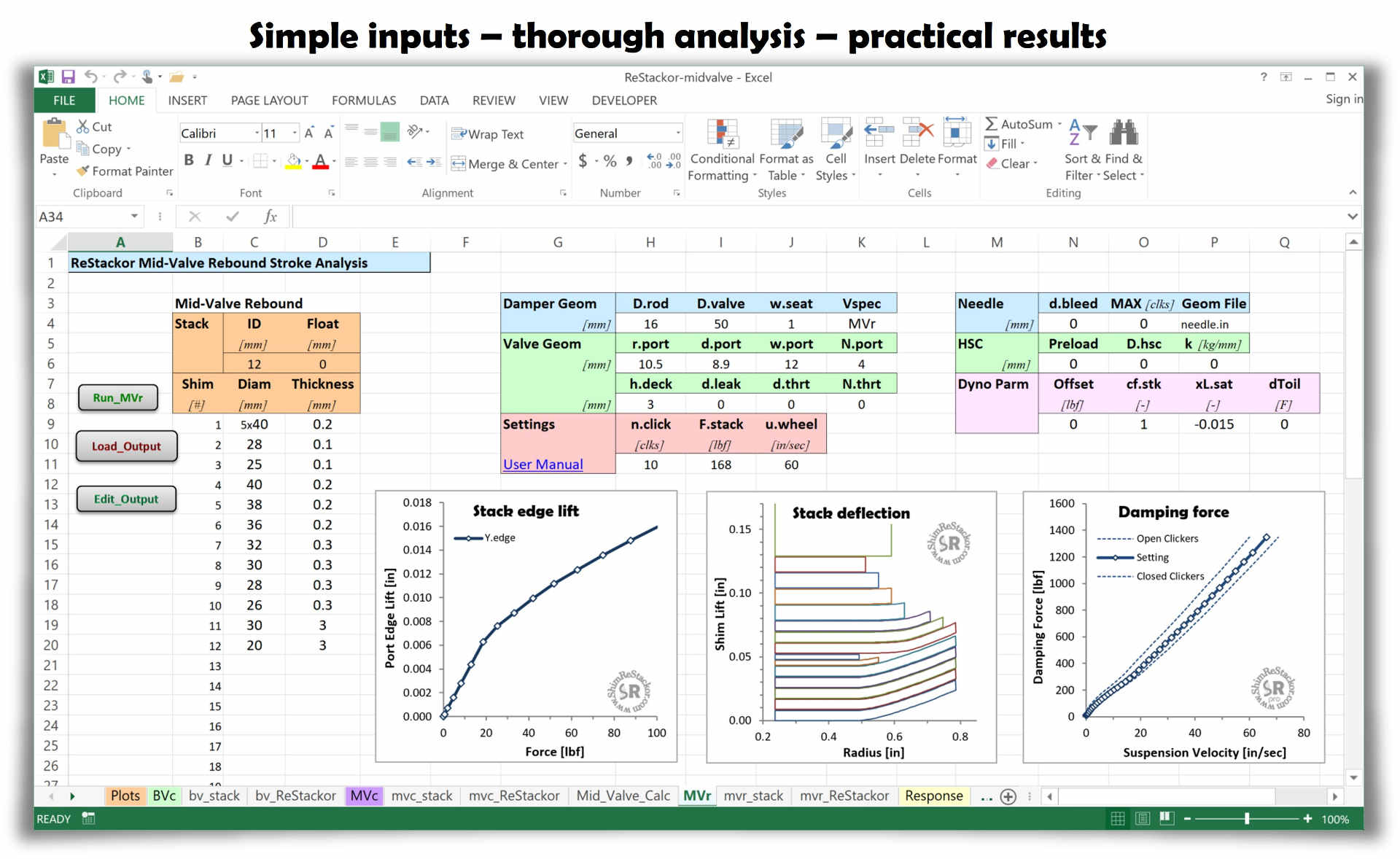
The requirement for accurate fluid dynamics and structural analysis creates a multi-physics problem. Solving the problem requires combining fluid dynamics, structural analysis and suspension response analysis tools into a single integrated package. Shim ReStackor integrates those multi-physics tools into a simple to use spreadsheet based analysis tool providing the capability to fine tune suspensions far beyond the limits previously possible.