
Spring-mass-damper theory applies the basic well known physics of F=ma to determine suspension system response. Force (F) acting on the suspension is the sum of spring plus damping force. Mass (m) is the chassis or wheel weight depending on which motion you want to examine. The combination of force and mass define the F=ma acceleration, which in turn specifies the suspension velocity and position at any instant in time through the suspension stroke.
- Spring force: Defined by the spring constant (k) multiplied by the displacement (dy) from full extension
- Mass: Wheel or chassis mass. Spring-mass-damper theory describes the motion of either body
- Damping: The shock absorber damping coefficient defined as damping force divided by shaft velocity
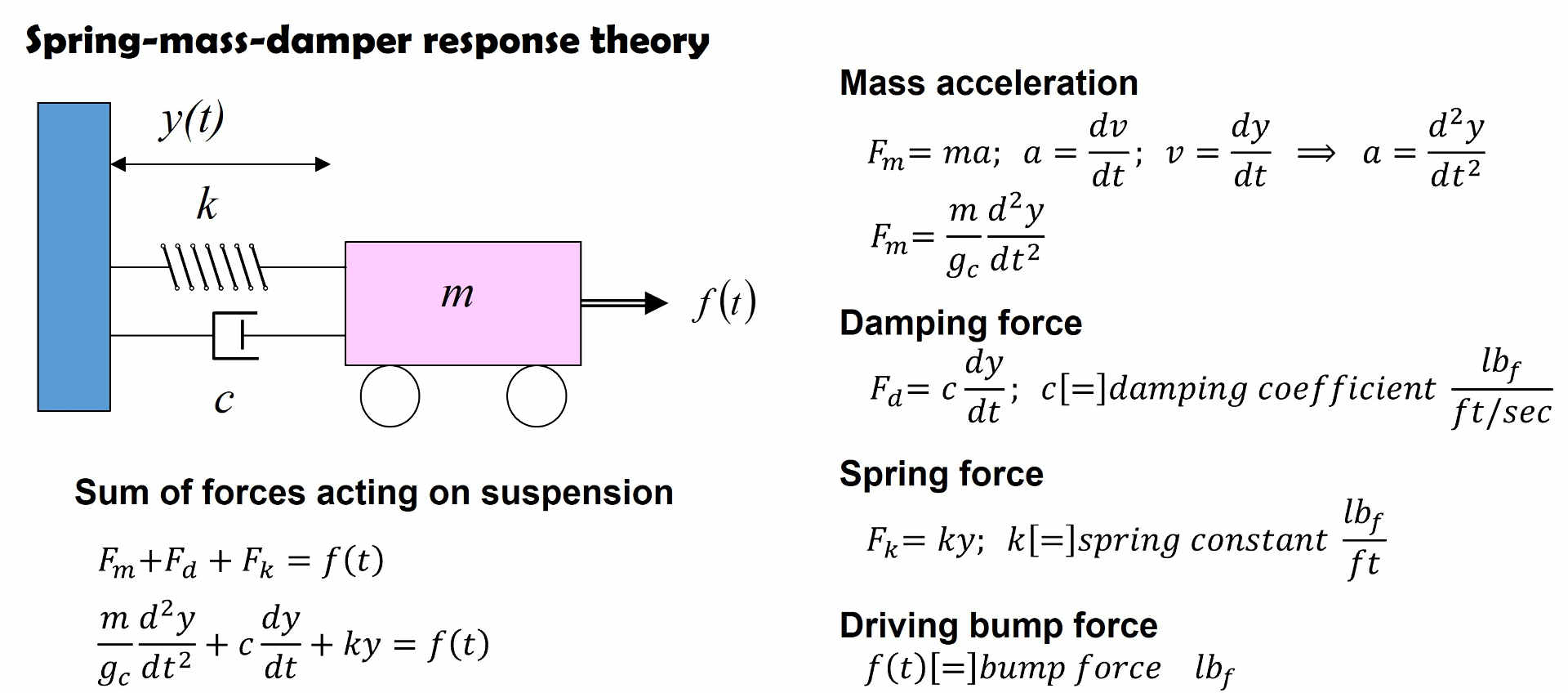
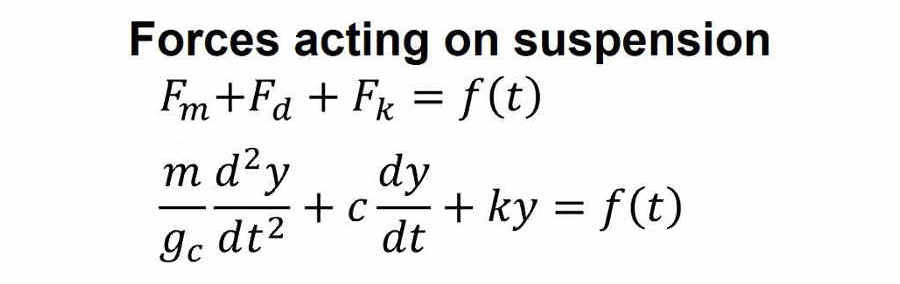
Specifying mass and the spring plus damping force completely describes the suspension motion. Springs make the suspension bounce up and down. Damping stops the bouncing motion. There are no other forces acting on the suspension. In that sense, spring-mass-damper theory provides an exact mathematical description of the suspension motion.
The f(t) term on the right-hand side of the suspension motion equation is the force transferred into the suspension at bump impact which sets the suspension into motion.
Suspension response
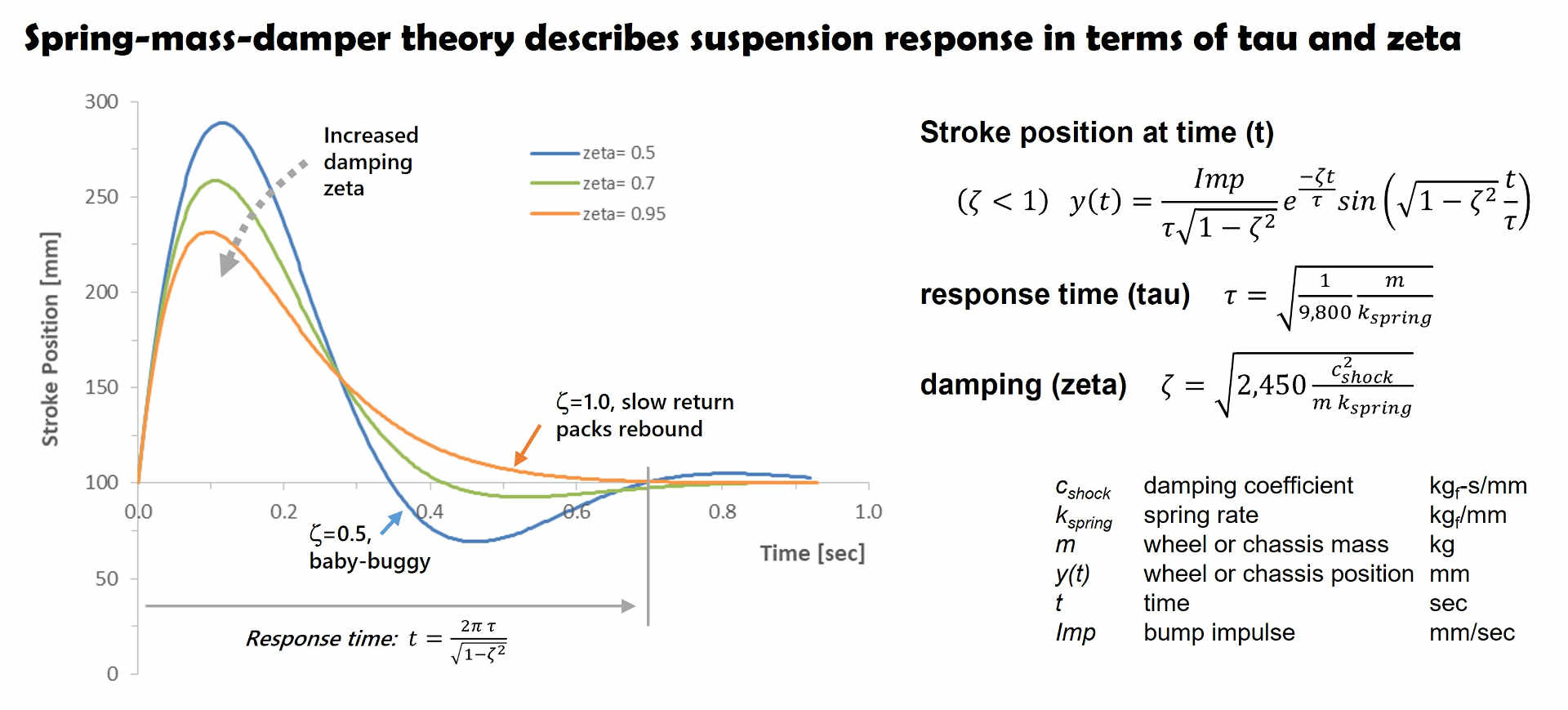
Solving the above force equation gives an exact mathematical equation describing the suspension position y(t) at any instant in time. The y(t) solution for an under damped suspension (zeta <1) is shown below.
Suspension velocity continuously changes through the stroke and the change in velocity changes the damping force while the change in position changes the spring force. The continuous change in force with both velocity and position makes it hard to guess suspension response.
Spring-mass-damper theory simplifies the problem identifying there are only two parameters that control suspension motion:
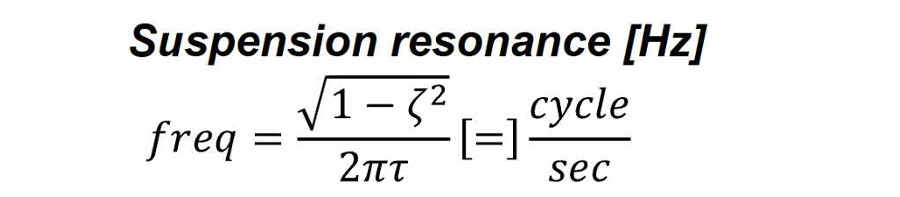
- tau: Defines the time required for the suspension to return to race sag which in turn defines the suspension resonance frequency
- zeta: Describes how quickly suspension motions damp
The combination of tau and zeta completely define the suspension response and ride frequency, aka resonance frequency.
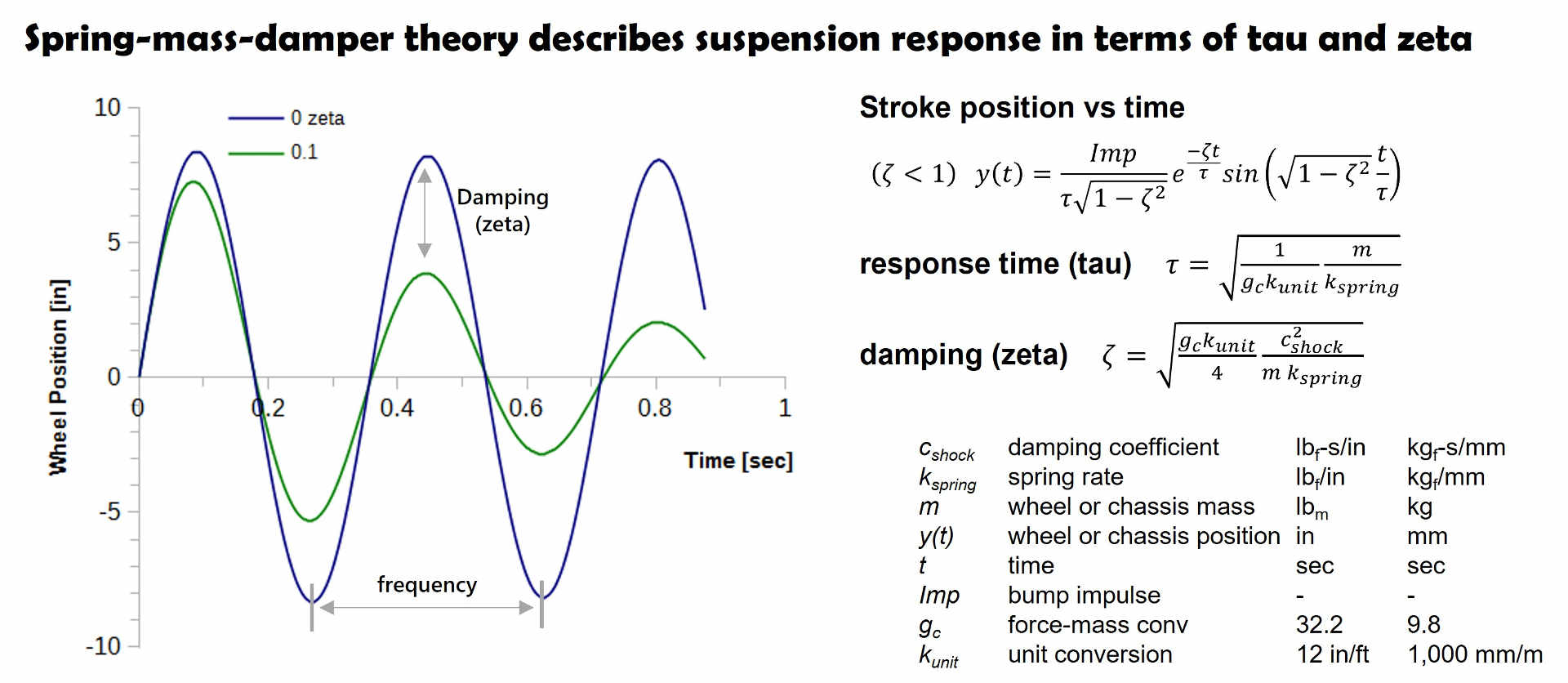
Any two suspensions, regardless of chassis weight, rider weight, spring rate or damping will produce exactly the same suspension response, retracing the above position and velocity curves, if the value of tau and zeta are the same.
That fact from spring-mass-damper theory provides a powerful suspension tuning tool providing a direct method to scale suspension setups from one bike to another by adjusting damping to correct for differences in rider and chassis weights.
Weight scaled suspension setups
The spring-mass-damper variable Tau is simply the ratio of mass to spring rate. Weight [lbm] divided by spring rate [lbf/in] is equal to race sag. Setting race sag to the same value sets tau to be the same which in turn sets the suspension undamped natural frequency to be the same.
Zeta defines damping. Zeta also includes mass and spring rate but adds the third parameter of damping in terms of the shock absorber damping coefficient (c). Tuning damping on different bikes to match zeta values sets the suspension response, “feel” and behavior to be the same.
Weight scaling Tau and Zeta values forms a powerful suspension tuning tool allowing the performance of a known good suspension setup to be scaled across a wide range of bike weights, rider weights and spring rates duplicating the suspension performance.
The Shim ReStackor weight scaling spreadsheet makes weight scaling easy. The single input of spring rate scales the damping of a known good setup to the spring rate and rider weight of a new setup. Correcting performance simply requires hacking around on the shim stack configuration to match the target damping curve. (linky sample apps weight scale).
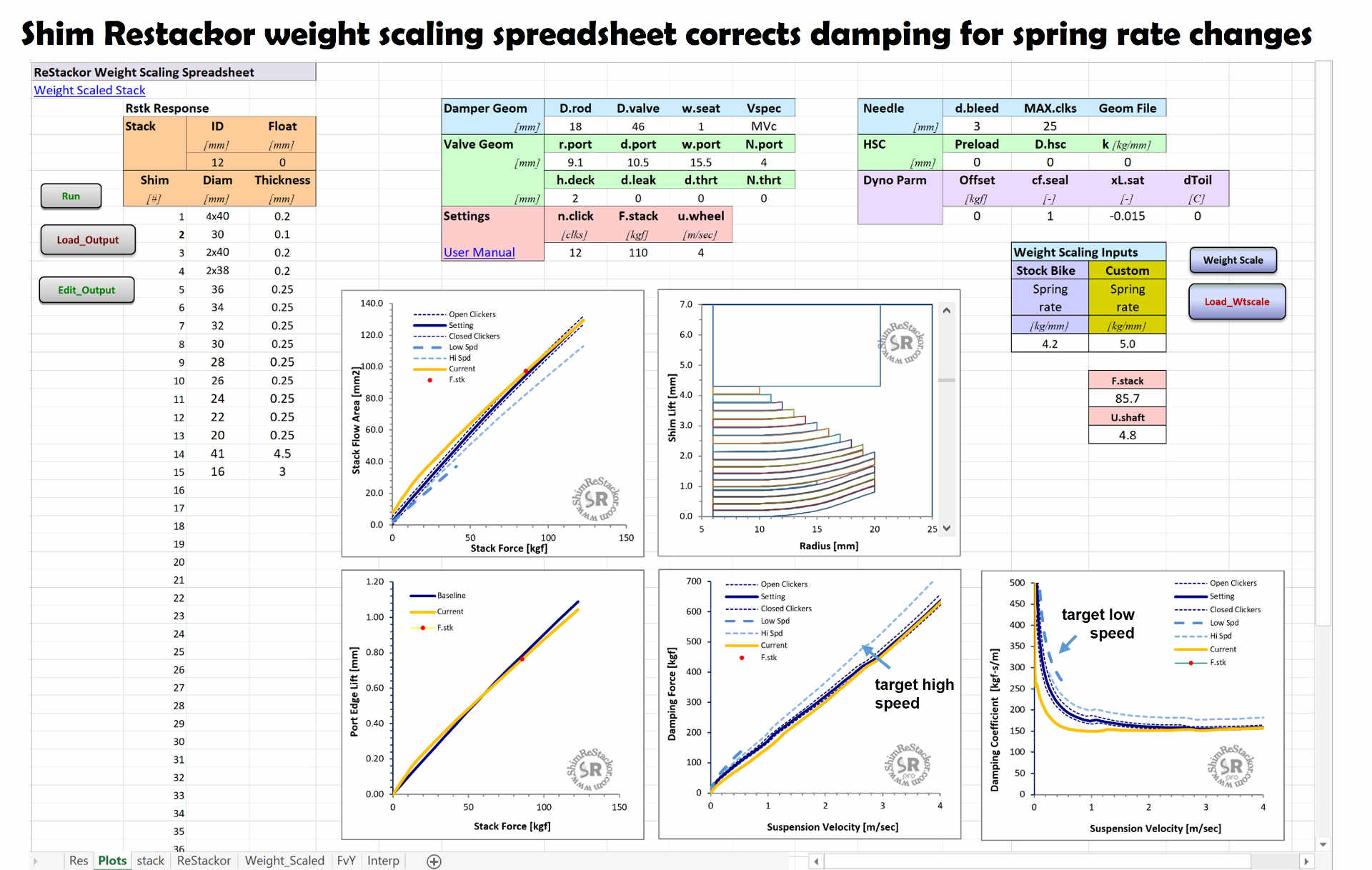
A second use of weight scaling is correcting stock damping for the change in spring rate needed for a lighter or heavier rider. Weight scaling provides a physics based method to correct the stock damping curve for changes in spring rate and restore the suspension response, “feel” and behavior the manufacturer intended for the original stock suspension setup.
Weight scaling the custom shock tuning from your old bike to a new bike and correct for differences in valve port geometry, bike weight and spring rate, to duplicate the performance of the original setup. Weight scaling the oil setup gets you in the ballpark of a workable setup out of the box instead of spending weeks investigating random shim stack configurations trying to get to a baseline.
Optimum rebound damping
Spring-mass-damping theory defines damping in terms of zeta. Zeta values of 1.0 are critically damped meaning the suspension smoothly returns to race-sag and will not overshoot race-sag or baby-buggy after a bump. Zero overshoot is desirable, however the stiff rebound damping needed to prevent overshoot produces a slow response causing the suspension to pack on closely spaced bumps.
Lighter damping at zeta 0.5 returns the suspension to race sag faster, reducing packing, but the residual suspension velocity on return to race-sag causes the suspension to overshoot race-sag and baby-buggy back. Baby-buggy motions bouncing around race-sag gives poor suspension “feel”.
Suspension resonance
The worst possible scenario for a suspension is hitting the next bump while the suspension is still recovering from the previous bump. When that happens the current bump impact augments the residual suspension motions from the previous bump driving the suspension into resonance.
Spring-mass-damper theory defines the rebound damping stiffness required to suppress suspension resonance as zeta values of 1/sqrt(2)= 0.707 or higher.
That fact from spring-mass-damper theory uniquely defines zeta values of 0.707 to give the fastest possible rebound response (supressing packing) with damping that is still stiff enough to suppress suspension resonance. Optimum rebound damping at zeta values of 0.7 has been verified through years of racing.
Spring mass damper theory
Suspension motions are complex. Spring-mass-damper theory breaks that complex problem down to identify the two fundamental parameters controlling suspension motions:
- tau: Defines how long the suspension takes to return to race sag
- zeta: Defines how quickly oscillations damp
Any suspension, regardless of weight, spring rate or damping, will give exactly the same motion and response if the values of tau and zeta are the same.
When installing a stiffer spring, spring-mass-damper theory provides a direct physics based method to determine the damping change needed. You don’t have to guess. Matching zeta between setups provides a direct method to get you in the ballpark of a good workable setup. That lets you focus on fine tuning instead of spending weeks trying to get back in the ballpark of a good workable setup.