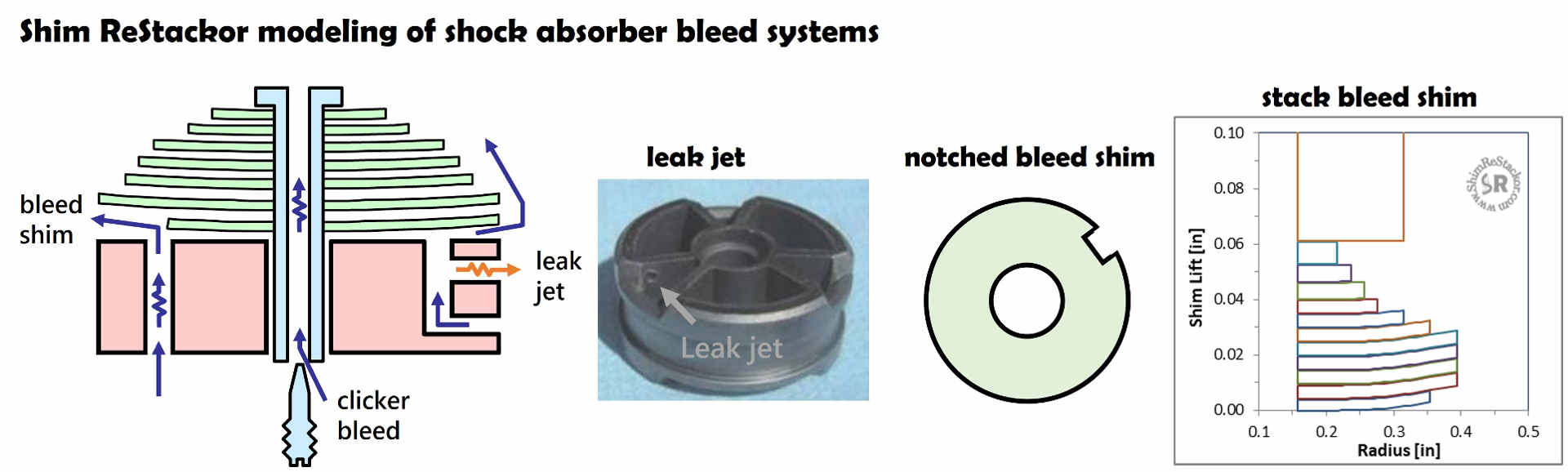
Bleed systems provide a controlled leak path bypassing the shim stack at low speed. Low flow resistance through the bleed allows the suspension to freely return to race sag on low speed suspension motions.
Suspension “feel” heavily depends on bleed. Shock absorbers use numerous bleed system styles to get control of low speed suspension motions.
Damping curve "knee"
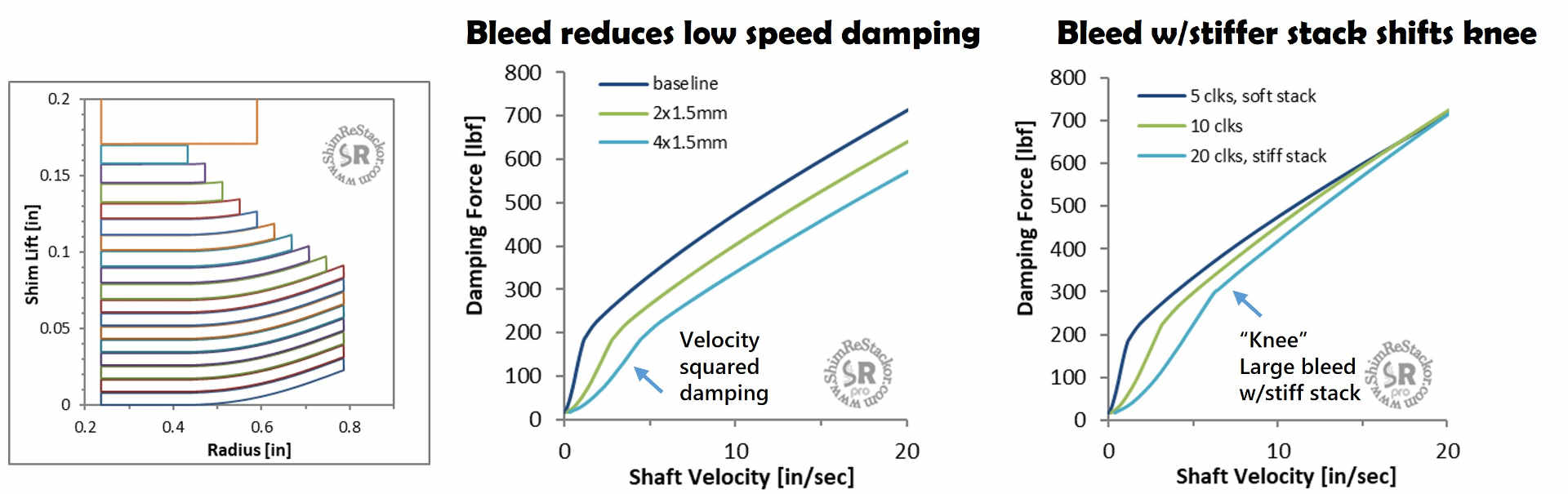
Clicker bleed circuits, leak jets, stack float or bleed shims all have a fixed constant area throat. Flow resistance is near zero at low speed and increases with velocity squared. The velocity squared pressure increase eventually produces enough backpressure to crack the shim stack open. Above the cracking pressure, the additional flow through the shim stack controlled valve produces a digressive damping force curve.
The transition from velocity squared orifice damping to shim stack controlled digressive damping puts a “knee” in the damping force curve. The location of the “knee” is controlled by the shaft velocity where the shim stack cracks open which is controlled by the bleed circuit flow area and shim stack stiffness.
Increasing the leak area provides more suspension compliance for rolling over trail trash. Decreasing the leak area provides more cornering “feel” and reduced brake dive.
Clicker needles
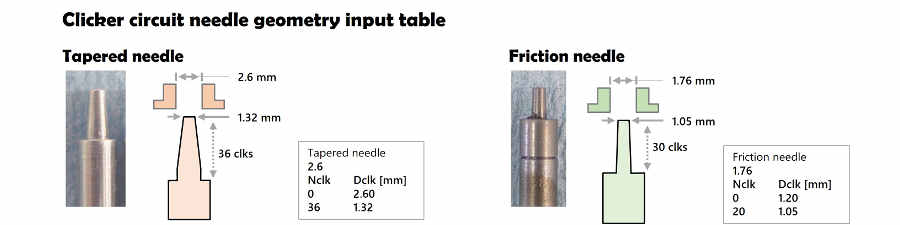
The clicker bleed circuit is basically a needle valve. Accurate damping force calculations require a clicker needle geometry table to describe the needle taper versus clicker position. The geometry table is a simple listing of needle diameter as a function of clicker position. Details are listed in the User Manual.
There are two basic styles of needles:
- Tapered needle: Screwing the needle in reduces the flow area
- Friction needle: Screwing the needle in increases the length of the high velocity throat increasing viscous friction losses
Clicker bleed losses
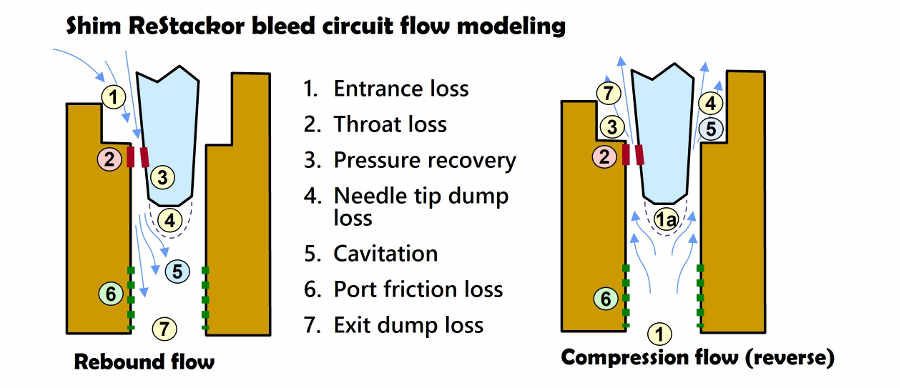
Seven types of flow losses occur in the clicker bleed circuits. Due to the geometry, flow losses are slightly different in the forward and reverse (rebound) direction (linky 1b_fluid_dynamics).
Low speed valve (LSV) shim stack
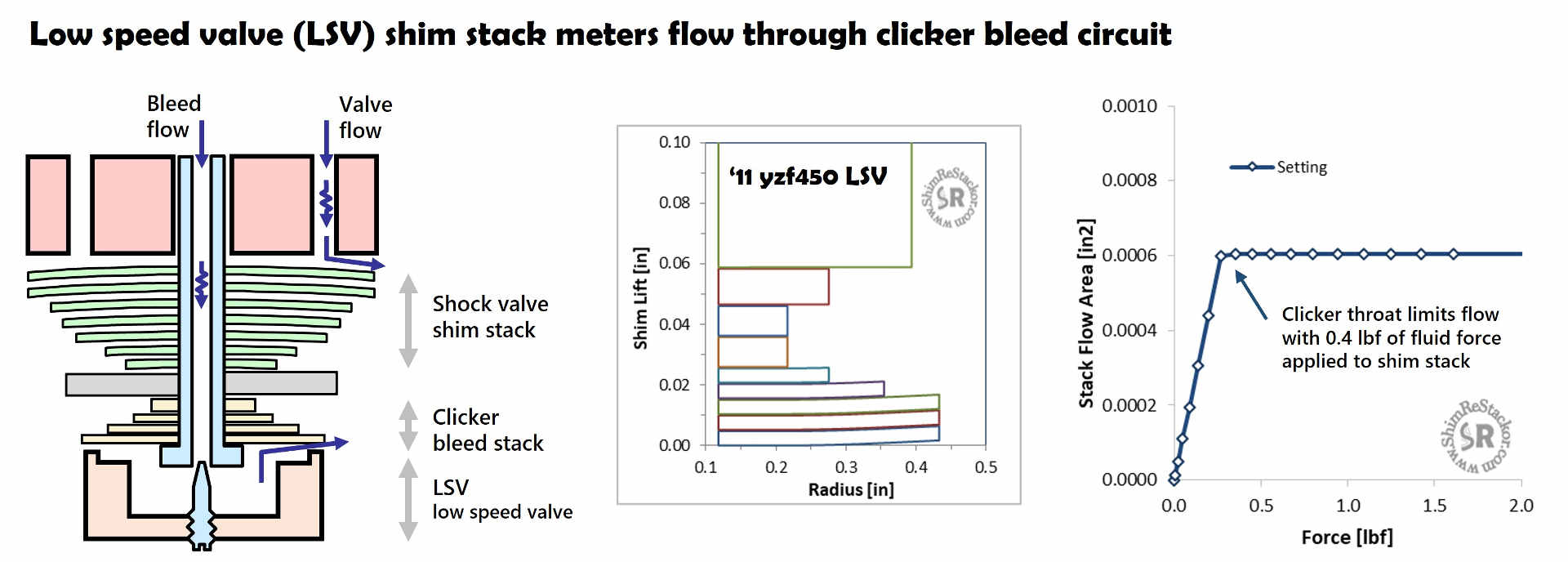
Low speed valve (LSV) refers to a shim stack located on the exit of the clicker bleed circuit. Flow through the valve is small and limited by the clicker needle position. The LSV circuit is modeled in Shim ReStackor setting the valve port throat diameter (d.thrt) equal to the clicker needle flow area and modeling the shim stack in the usual way.
The example below computes the damping force for an ‘11 yzf450 fork base valve LSV circuit. With a fluid force of 0.4 lbf applied to the shim stack the flow area through the LSV shim stack has deflected to the point where the clicker throat area limits the flow through the bleed circuit.
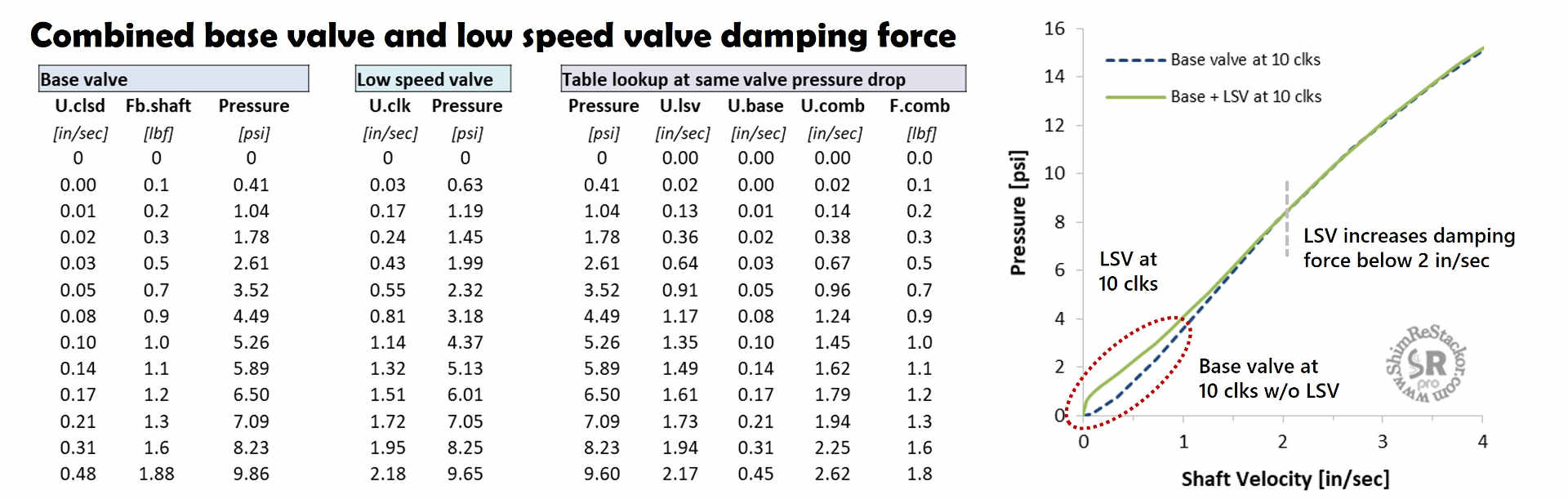
The LSV circuit creates two parallel fluid circuits through the fork base valve and LSV clicker circuit. Computing damping performance of the LSV circuit requires combining two separate Shim ReStackor calculations. The first calculation computes damping force through the base valve with the clickers closed. The second calculation computes damping force through the LSV circuit with the valve throat area set equal to the clicker throat area.
The two calculations are combined by selecting a sequence of progressively higher pressure drops and looking up the flow and shaft velocity through the base valve and the flow through the low speed valve at the same pressure drop. The total flow through the combined circuits is simply the sum of the two shaft velocities. At the selected valve pressure drop, the base valve damping force specifies the force on the shock shaft.
For the ‘11 yzf450 example, the LSV increases low speed damping by approximately 1 lbf up to shaft speeds of 2 in/sec. Above 2 in/sec the LSV shim stack has deflected to the point where the clicker throat limits the flow. Shim ReStackor calculations running the fork base valve only with clickers set at 10 out (dashed blue line) match the high speed LSV calculations since both are running the same bleed area.
Rebound separator valves on a shock operate in a similar fashion and primarily function as a check valve preventing reverse flow. The damping force contribution from the fork LSV is small contributing approximately 1 lbf over the zero to one in/sec range.
Stack float
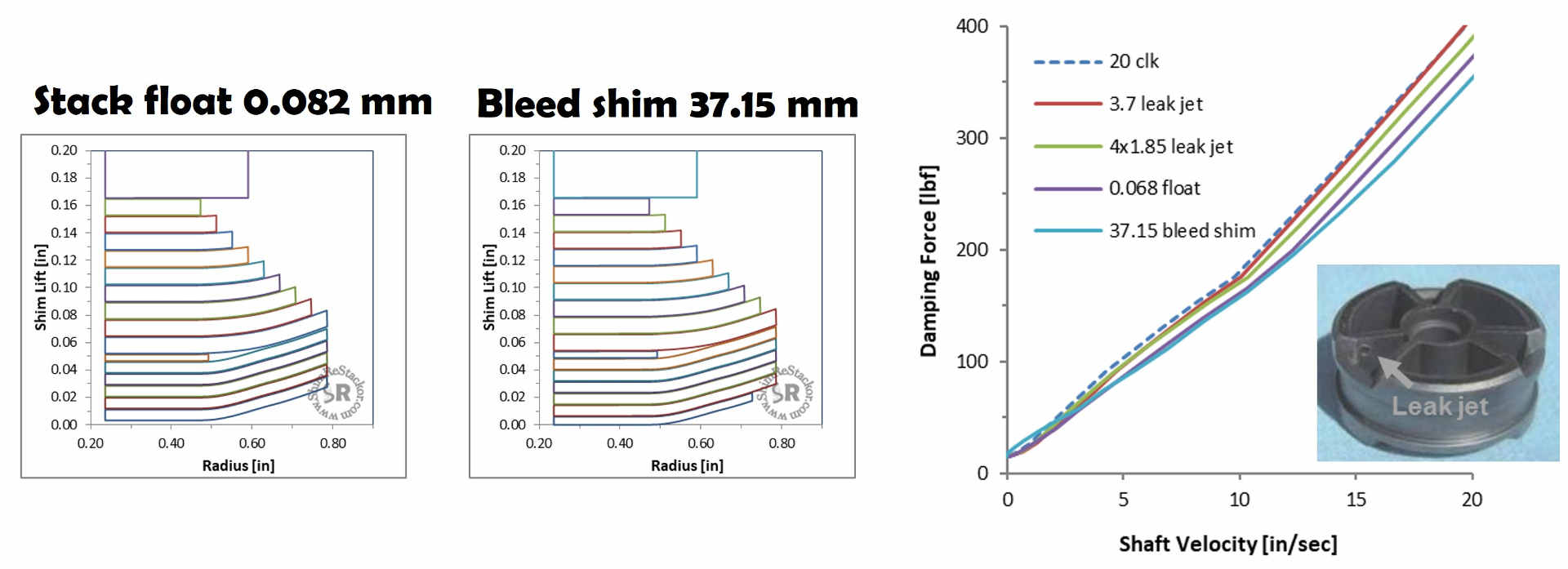
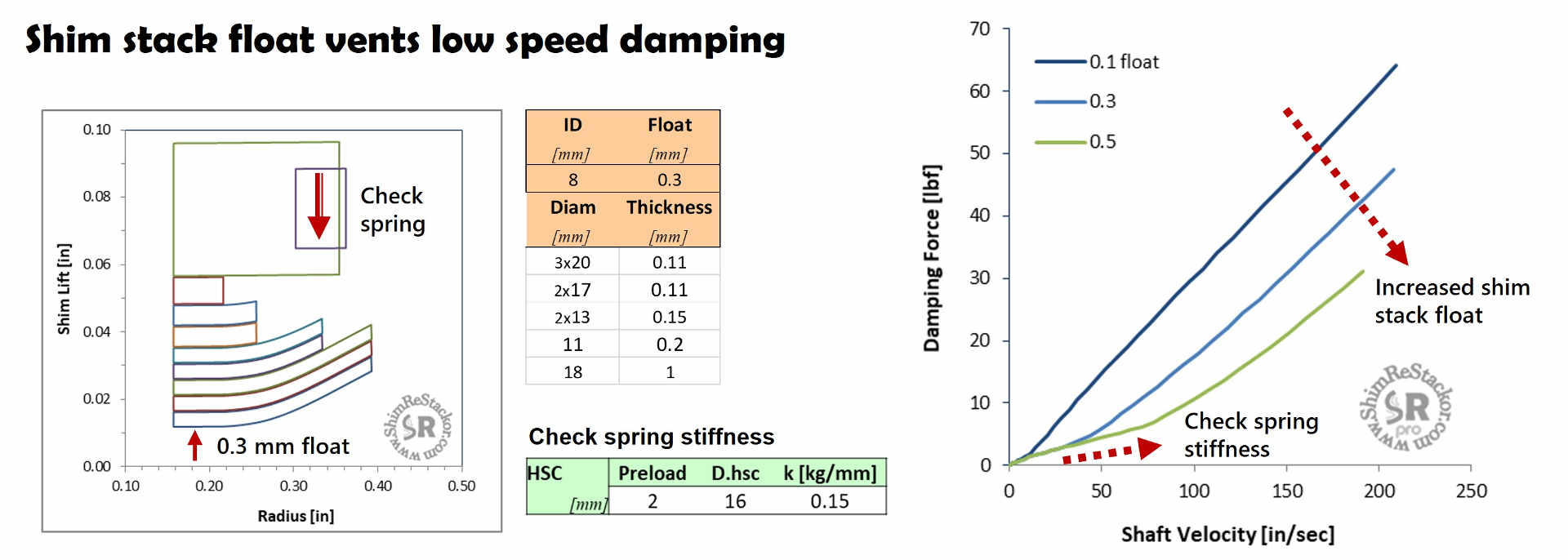
Float allows the shim stack to physically lift off of the valve face and vent low speed damping. The rate of float opening is controlled by the HSC spring stiffness and the float cracking pressure controlled by spring preload.
The “Float” input specifies the float travel limit. Beyond that limit, the shim stack clamp hits a hard stop and damping force is controlled by the shim stack deflection as the shock is pushed to higher velocities (linky sec 3b5_stack_float).
Leak jets
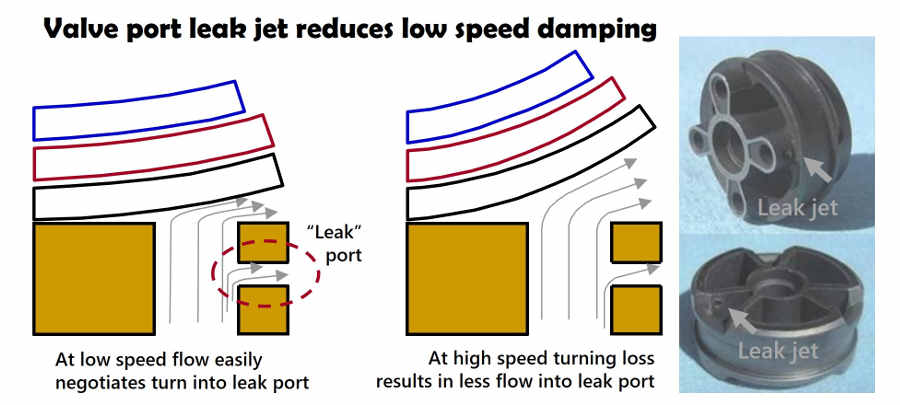
Leak jets are small holes drilled in the side of the valve port. Pressurized fluid in the valve port escapes through the leak jet venting low speed damping.
At high speed the 90 degree turn into the leak jet port reduces the flow effectiveness of leak jets.
Multiple leak jets
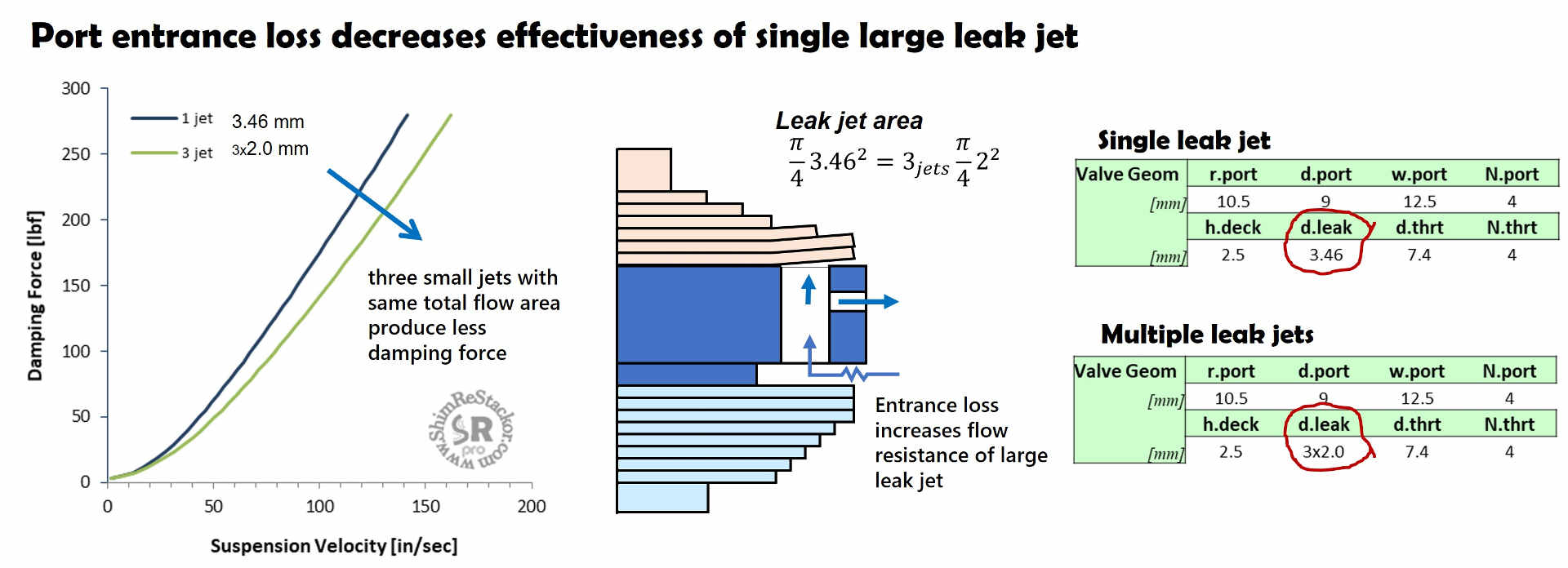
A single 3.46 mm diameter leak jet has the same flow area as three 2.0 mm jets. However, 2.0 mm leak jets installed on three ports produces a more effective bleed then on large 3.46 mm hole on a single port.
The difference is caused by flow losses at the port entrance. A single 3.46 mm leak jet on one port increases the fluid flow through that port, which increases flow losses at the port entrance.
Spreading the leak jet across three ports increases the flow through each port by a small amount and since flow losses increase with velocity squared, the small increase in entrance flow loss spread across three ports is less than the large increase on a single port.
A central focus of the physics based models used in Shim ReStackor is application of the fundamental physics of fluid dynamics to account for multiple flow losses occurring in the shock fluid circuits both in series and in parallel. Those flow losses make the flow “effectiveness” of a single leak jet, multiple leak jets, bleed shims or clicker bleed all slightly different and the physics based modeling in Shim ReStackor captures those differences.
Notched bleed shims
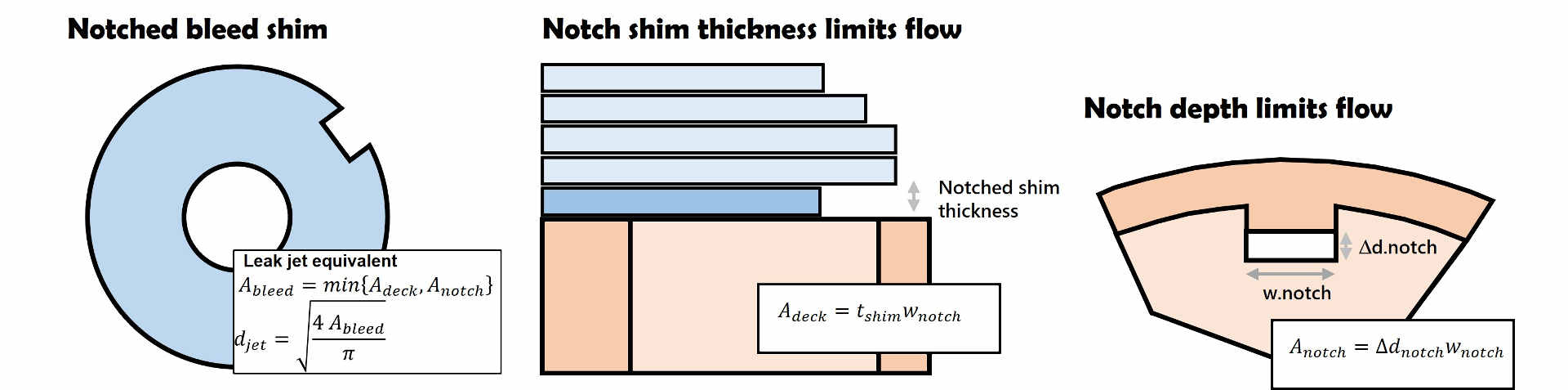
Notched bleed shims provide a controlled leak at the valve seat. The notch width, depth and shim thickness define the leak area.
On a notched bleed shim the minimum flow area occurs at one of two locations:
- The bleed shim thickness sets a gap height restriction on the valve seat (A.deck)
- The notch depth sets a restriction on the valve diameter (A.notch)
The controlling bleed flow area is the minimum of the two.
Shim ReStackor models notched shims as a leak jet with the leak jet flow area set to the minimum of A.notch or A.deck.
Bleed shim
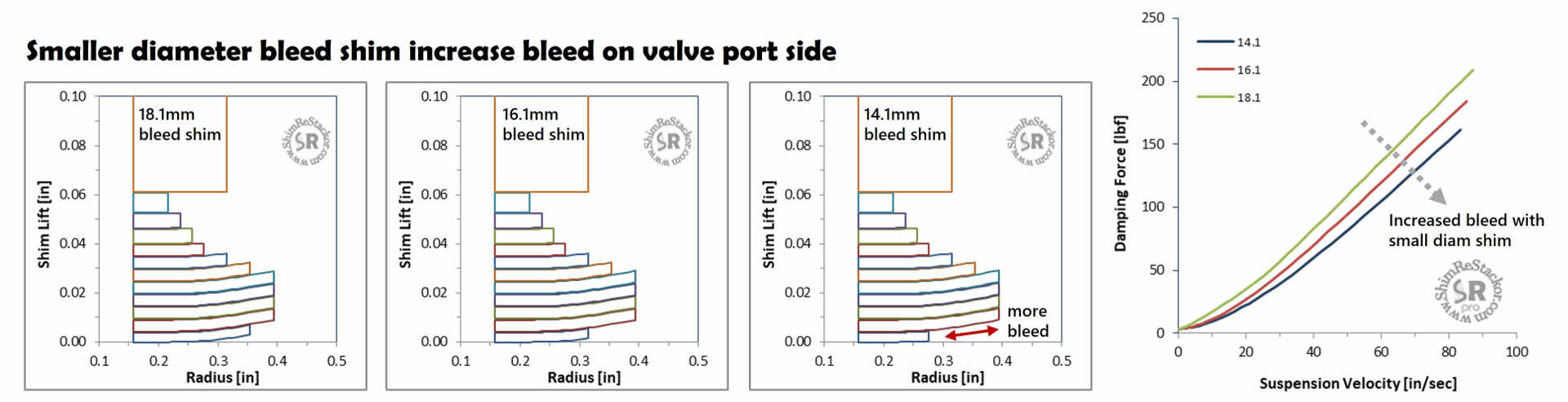
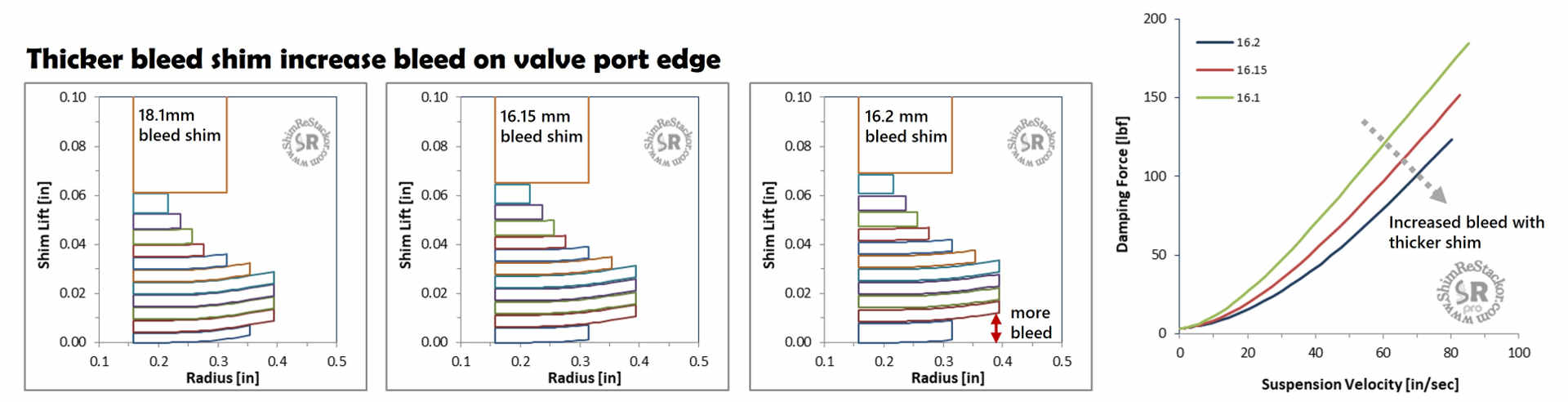
Face bleed shims have a diameter that is smaller than the valve seat.
Decreasing the bleed shim diameter increases the gap between the shim and valve port edge allowing more bleed flow and softer damping.
Increasing the bleed shim thickness increases the gap height at the valve port edge.
Thicker bleed shims increase the gap, giving more bleed flow area and softer damping.
Bleed system tuning
Notionally, 1.0 mm2 of bleed area through the clickers, leak jet, bleed shim, or stack float all produce the same effect. In detail, each circuit produces a slightly different flow resistance and dependence on oil viscosity and density which results in different flow rates for the same bleed area.
However, those differences don’t really matter. For tuning with Shim ReStackor, bleed circuits can be used individually or in combination and the bleed parameters modified until the desired damping force value is achieved. In that sense the exact performance differences between the various bleed circuits don’t really matter, the flow area through the various styles of bleed circuits can be adjusted to hit the desired damping force target.
- Fine tune your suspension setup far beyond the limits previously possible