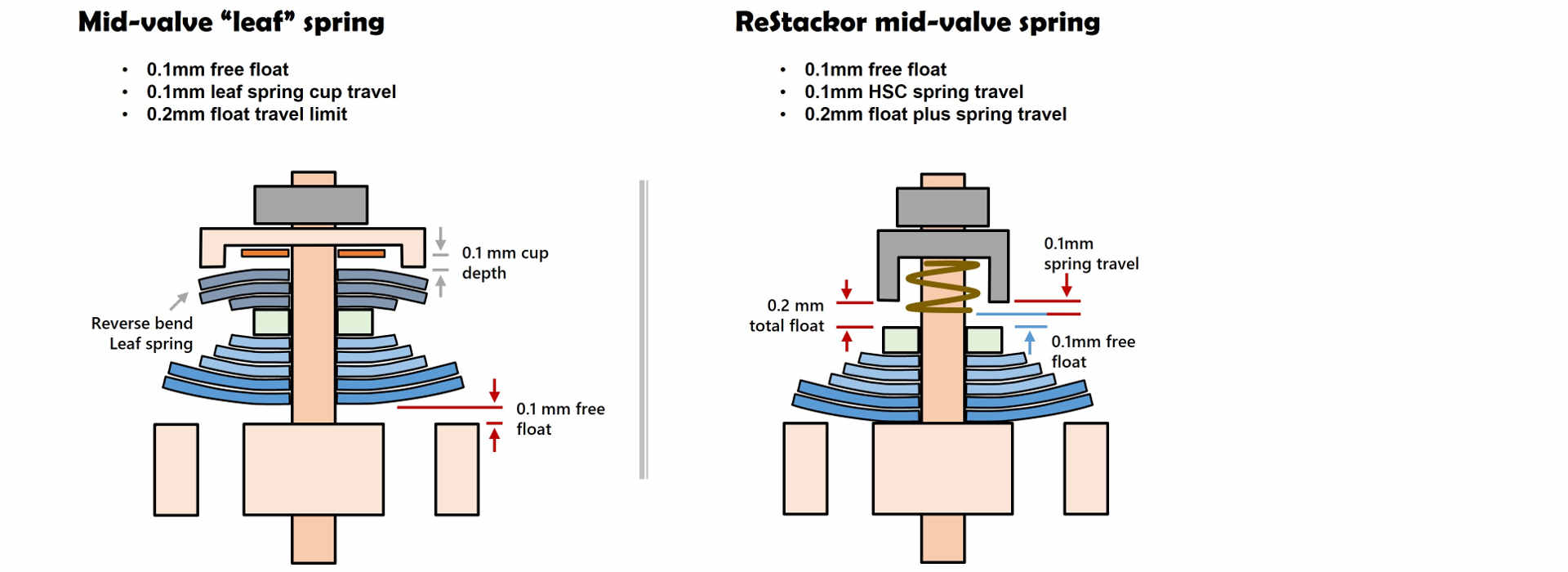
A “leaf-spring” is a stack of shims above the clamp that bend backward into the clamp washer cup. Deflection of the leaf-spring floats the shim stack. Spacers in the cup limit the leaf-spring travel and the maximum stack float.
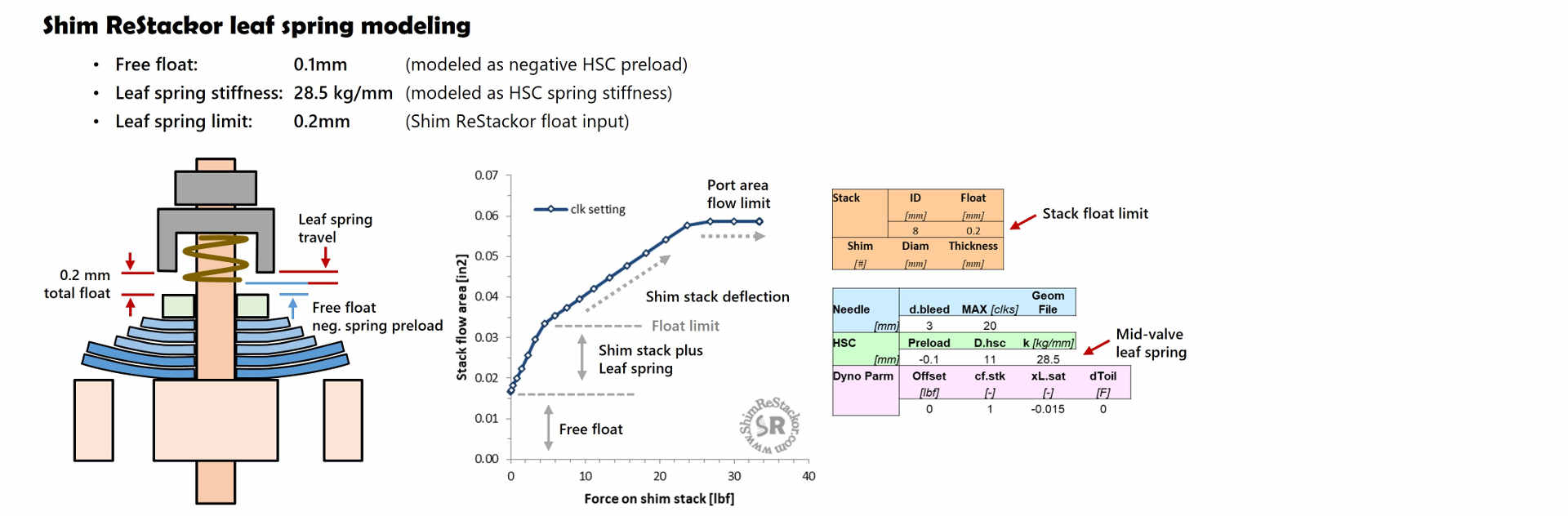
Shim ReStackor models leaf-springs using the high speed compression adjuster (HSC) inputs. Negative spring preload specifies free-float. The HSC coil spring stiffness specifies the leaf-spring stiffness and the shim stack float input specifies the max float travel where the leaf-springs bottom in the clamp washer cup.
Leaf-spring stiffness
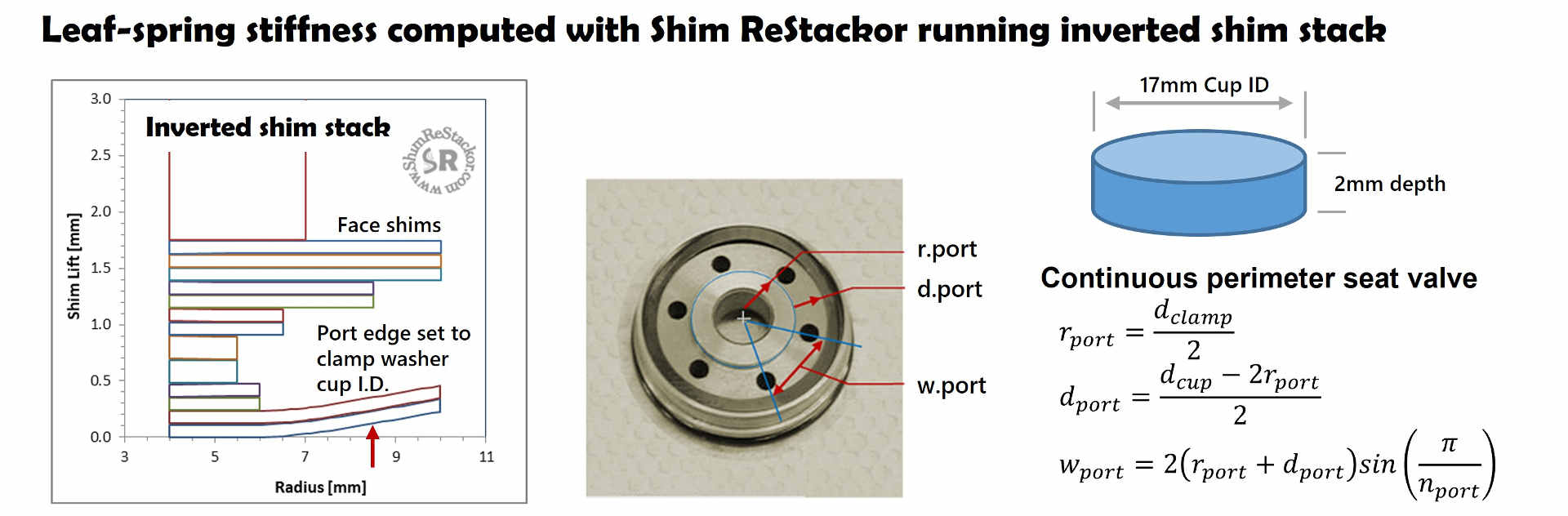
Stiffness of the reverse bend leaf-spring is determined running a separate Shim ReStackor calculation with the shim stack inverted. The inverted stack puts the leaf-springs on the valve face.
The leaf-spring valve cup is configured as a perimeter seat valve with the seat diameter matching the cup diameter. The stack clamp diameter of the leaf-spring defines r.port and the clamp washer cup radius defines r.port + d.port radius.
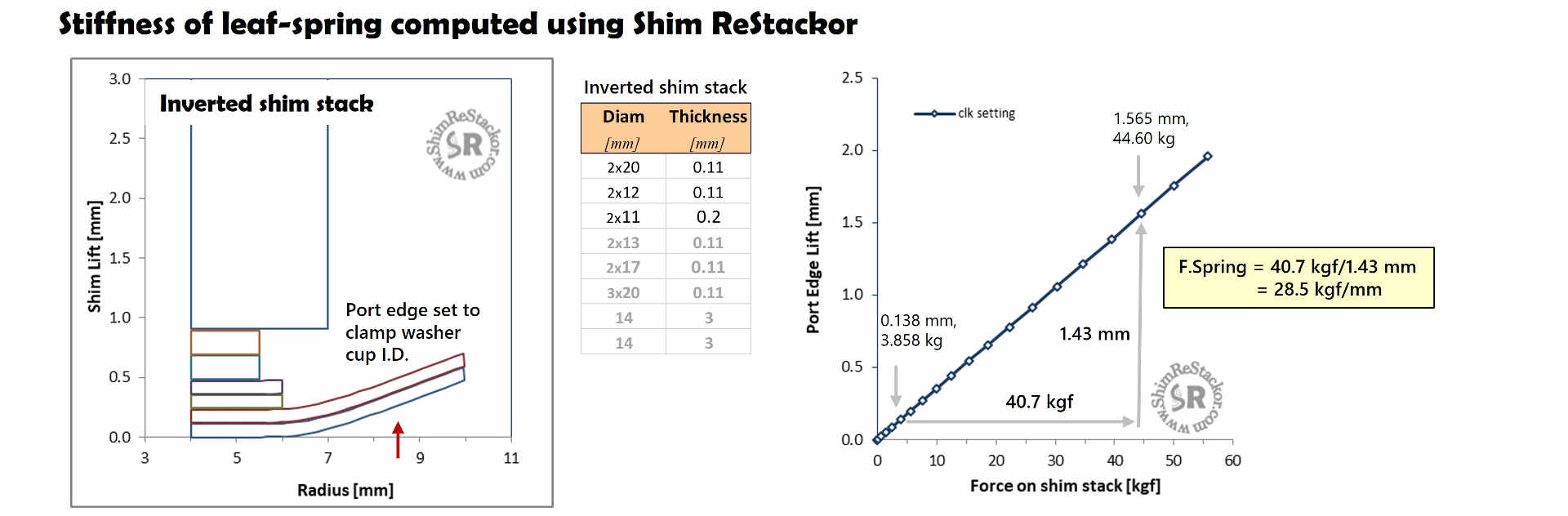
The port edge lift computed by Shim ReStackor gives a direct measure of leaf-spring stiffness. Over the 2mm of leaf-spring travel the stiffness is nearly linear. Linear stiffness makes the HSC coil spring used in Shim ReStackor modeling a good approximation since the coil spring also has a linear stiffness.
The spring rate of the leaf-spring is simply specified as force divided by displacement. Picking points off of the computed port edge lift curve shows the leaf-spring stiffness is 28.5 kgf/mm.
Lear spring tuning
Three Shim ReStackor inputs define leaf-spring performance:
Negative spring preload: Negative preload allows the stack to float off of the valve face before engaging the HSC coil spring. In the example free float is 0.1 mm.
HSC spring stiffness: Deflection stiffness of the leaf-spring is modeled using the HSC coil spring. Fluid force applied on the shim stack face compresses the HSC spring progressively increasing the shim stack float.
Float: The Shim ReStackor float input defines the travel limit. At the float travel limit, the stack clamp hits a hard stop bottoming the leaf spring clamp in the cup.
Fork mid-valve tuning
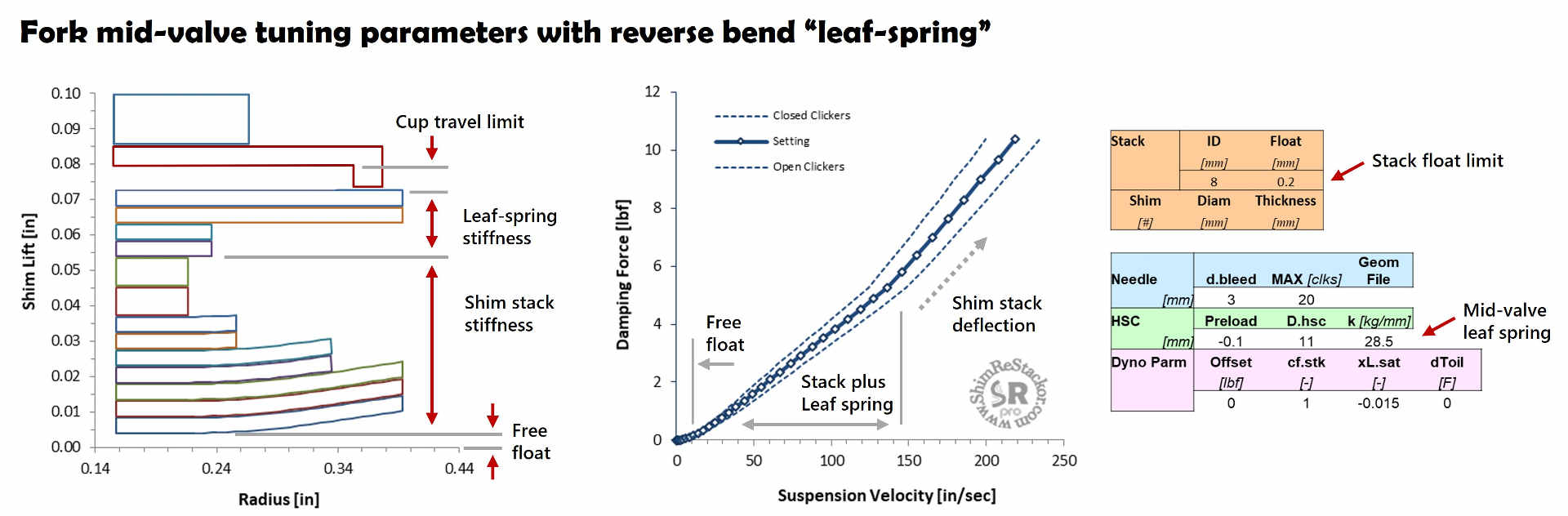
Free-float on the mid-valve sets the suspension velocity where the mid-valve begins generating compression damping force. Free-float is set in Shim ReStackor calculations by specifying a negative HSC spring preload, -0.1 mm in the example below.
In the second range, the combined shim stack deflection and reverse bend leaf-spring controls the shim stack edge lift, valve port flow area and ultimately the damping force. Modifying the leaf spring stiffness controls the slope of the curve through the second range.
At 150 in/sec the leaf-spring bottoms in the clamp washer cup. The Shim ReStackor float input specifies the travel limit of the leaf-spring and the point where it bottoms in the cup.
After the leaf spring bottoms, the shim stack stiffness controls edge lift deflection, flow area and the resulting damping force.
At ultra-high speed the valve port throat area limits the flow creating a fourth damping force range not shown in the example below.
Shim ReStackor models all four ranges of leaf spring mid-valve deflection. Parameters controlling the start and end of each range are tunable as well as the damping force through each range. Leaf-springs can be tuned for control of low speed damping or as a high speed blow-off system.