
MXScandinavia dyno tested shim factor equivalent shim stack configurations on Thumper Talk to determine the accuracy of shim factors in scaling suspension setups. By shim factor theory (linky, physics), a stack of 4x40.3 face shims should be 3.8% softer than a stack of 14x40.2 shims.
Dyno test results shows the actual difference was approximately double that at 7.7% shown by the data points in the figure below. Shim ReStackor analysis (lines in the figure below) show the same 7.7% difference in damping force.
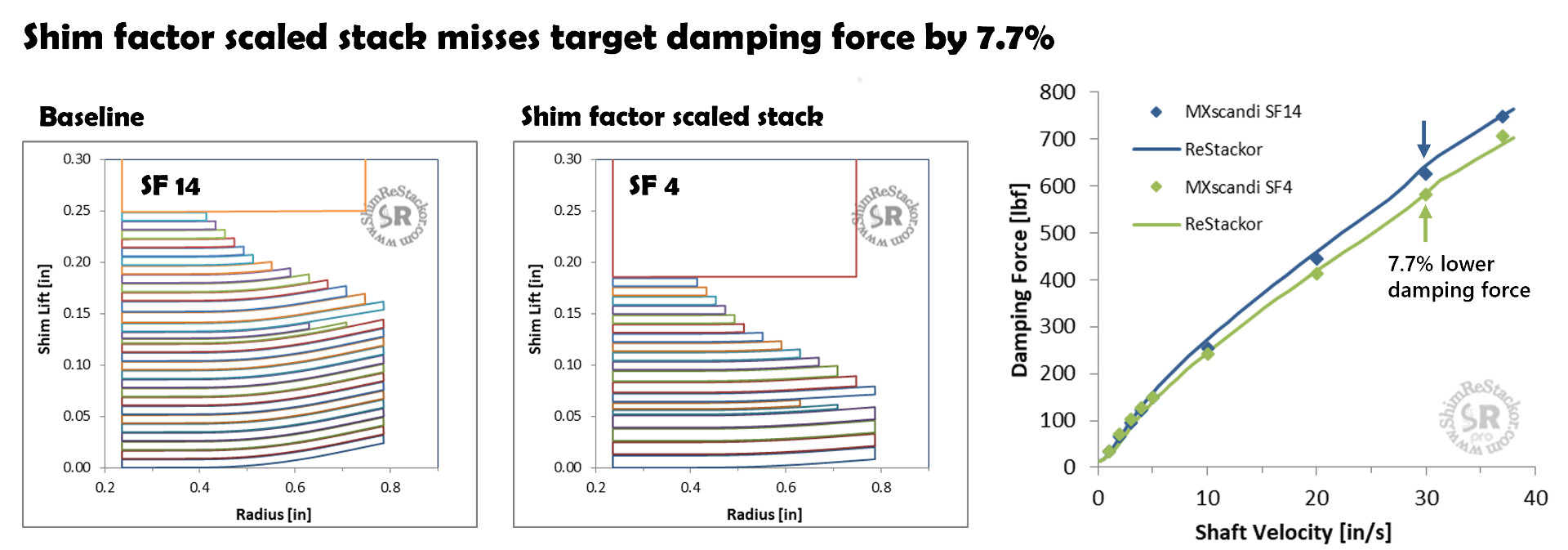
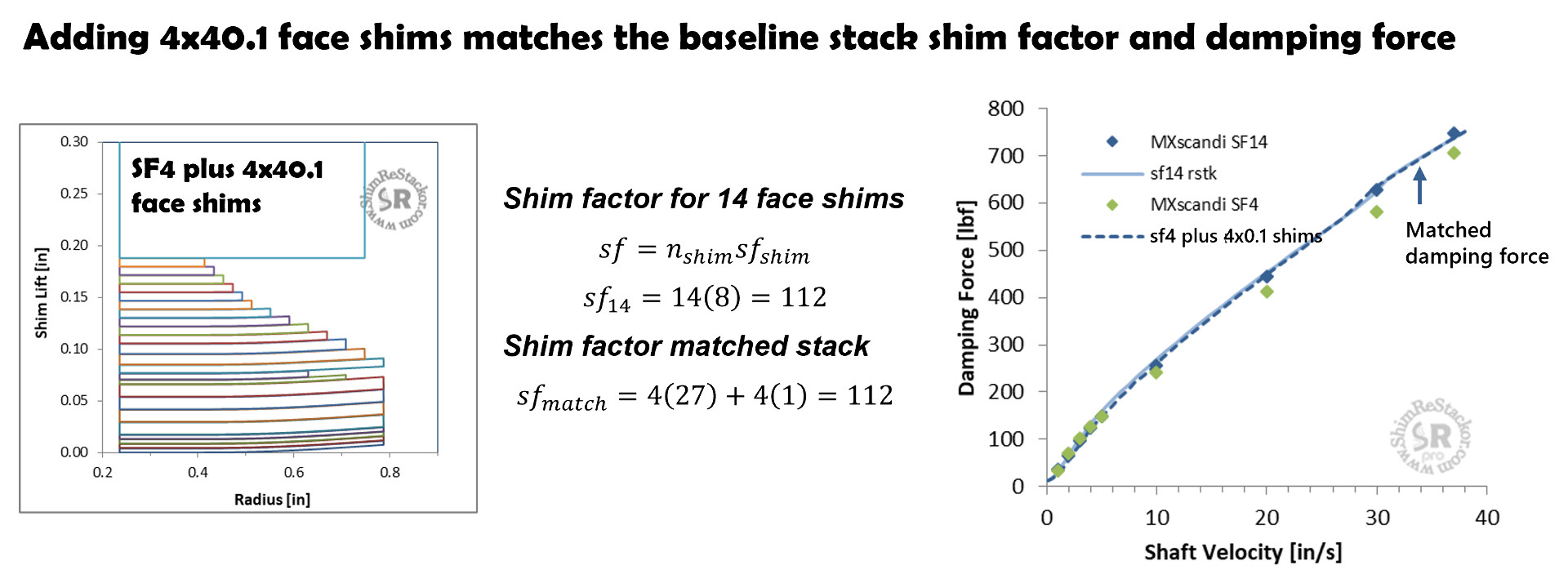
The baseline 14x40.2 stack has a shim factor of 112. The replacement stack of 4x40.3 face shims has a lower shim factor of 108. The stack can be modified to match the baseline configuration by adding four 4x40.1 shims (sf=4) to bring the shim factor up to 112.
Running Shim ReStackor with the additional 4x40.1 face shims shows the damping force matches the baseline 14x40.2 target configuration.
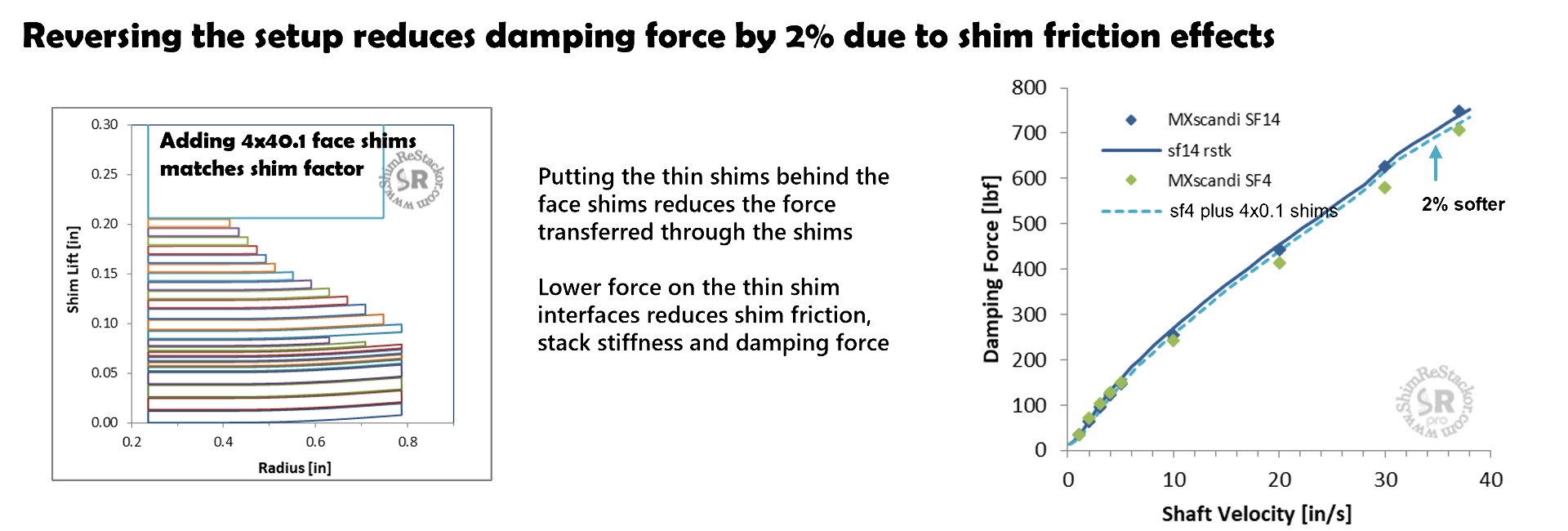
Running the replacement stack with the setup reversed to locate the thinner 4x40.1 shims behind the thicker face shims shows the damping force is 2% lower. The difference is created by shim friction. Locating the 4x40.1 shims on the face of the shim stack heavily loads the interface between each shim increasing the friction and stiffness of the shim stack.
Locating 40.1 shims behind the thicker 40.3 face shims allows the thicker face shims to transfer a portion of the load directly into the shim stack clamp. The reduced load on the thinner 40.1 shims reduces friction making the shim stack and damping softer when the face shim configuration is flipped.
Shim ReStackor FEA calculations compute the forces acting on the top and bottom surface of each shim. Quantifying forces acting on the shim interface allows accurate calculation of shim friction and its effect on stack stiffness.
Adding a thicker shim to the shim stack taper section, changes the shim interface forces for all of the shims below which alters the friction forces and the effective shim stack stiffness. Shim ReStackor FEA calculations are designed to correct for those effects.