Split crossover
Split crossovers (linky sample apps) use two shims to form the crossover gap. Split shims smooth the bend radius at the crossover shoulder and help prevent kinking of the face shims on the sharp shoulder of a single crossover shim.
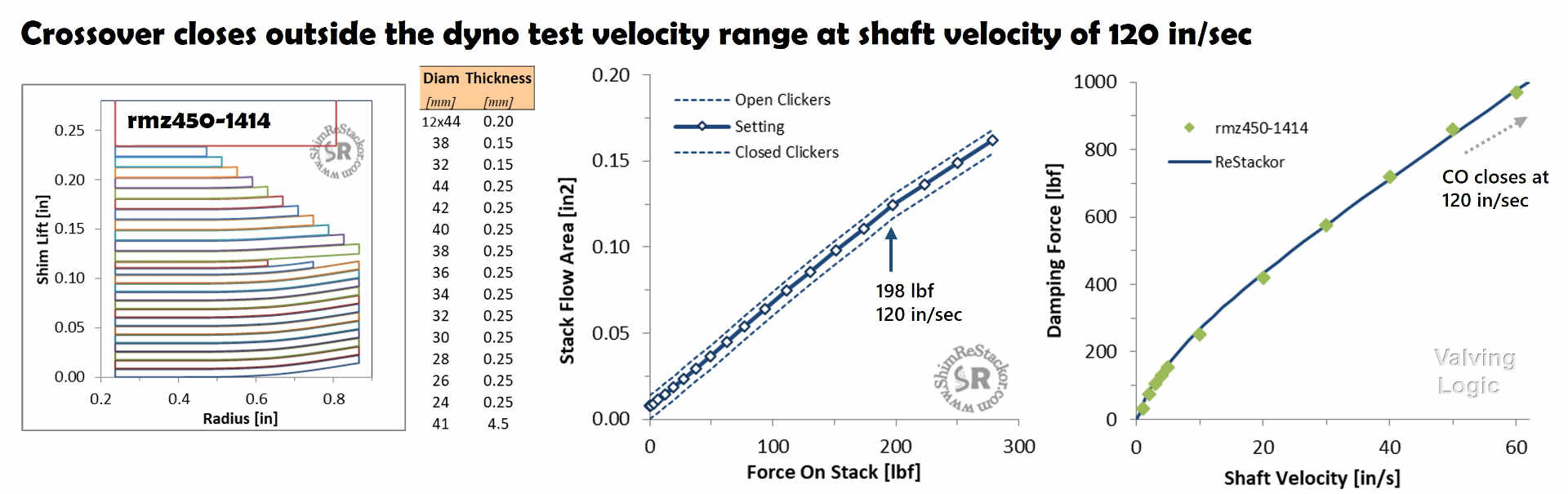
Valving Logic dyno testing of an rmz450 used a spit shim crossover with a crossover gap of 0.3mm. The large gap coupled with the stiff low speed stack produces a crossover closure velocity of 120 in/sec, roughly twice the dyno test speed capability.
The data illustrates a frequent dyno test frustration. At the limit of the dyno the crossover gap has not closed. Damping force will increase after the crossover gap closes, but there is no way to estimate the high speed performance from the data obtained.
The capability of Shim ReStackor to compute high speed performance helps to relieve those uncertainties and determine the effect of high speed crossover closures and valve port flow restrictions that kick in at high speed.
Damping curve shape tuning
MXSCandinavia on Thumper Talk demonstrated the shim stack modifications needed to separately control low and high speed damping:
- Preloading a soft shim stack increases damping force at low speed and softens damping force at high speed
- A crossover does the opposite producing softer low speed and stiffer high speed damping
- A soft tapered shim stack matches the crossover stack at low speed and drops off at high speed
Tuning shim stacks to get the desired damping force curve is simply done by hacking: adding or removing shim stack preload and crossovers to get the desired damping force curve shape and hacking the shim stack stiffness to get the desired damping force value. Obviously, multiple iterations are needed to simultaneously achieve the desired damping force value and curve shape.
The numerical test bed of Shim ReStackor makes that simple, easy and intuitive.
Interactive crossover rm85
Interactive crossovers use a shim diameter that is larger than the shim stack clamp. The larger crossover diameter transfers force from the face shims directly into the high speed stack forcing the high speed stack to deflect before the crossover closes. Interaction with the high speed stack softens the crossover closure event (linky sample apps).
Valving Logic on Thumper Talk demonstrated the performance of an interactive crossover. The damping force data shows no evidence of the crossover closing. However, Shim ReStackor calculations of the shim stack deflection and stack flow area make it easy to spot the crossover closure velocity at 20 in/sec.
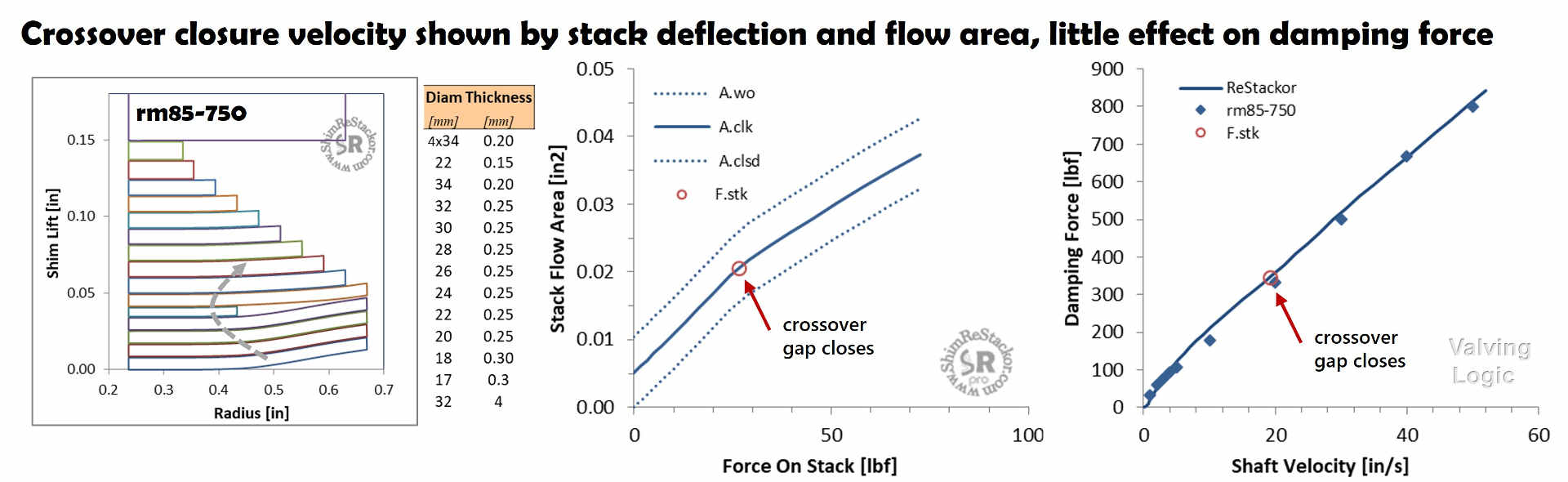
Soft closures of interactive crossover with a soft high speed stack often do not produce any specific “event” in the damping force curve. The data at 20 in/sec where the crossover closes shows that.
Crossover tuning
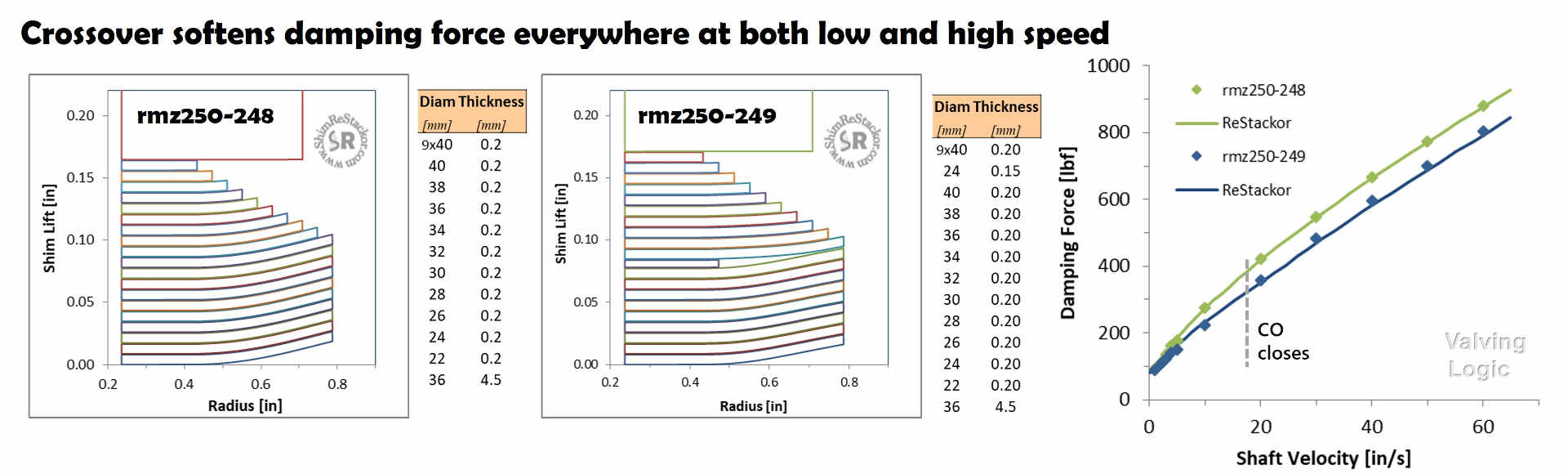
Valving Logic demonstrated the effect of adding a crossover to a simple tapered shim stack. Adding the crossover makes the damping force softer everywhere, not just at low speed.
Tuning crossovers to produce the single effect of softer low speed damping requires multiple changes to the shim stack:
- Adjust the crossover position
- Adjust the crossover diameter to produce the desired low speed damping
- Adjust crossover gap to produce the desired closure velocity
- Adjust the high speed stack to produce the desired high speed damping
There is no algebraic equation to “design” a crossover. Crossovers are tuned by hacking around on each of the above four parameters to hit the desired ow damping target while maintain the same high speed damping. That is a tedious process on a dyno, but rapid Shim ReStackor calculations make the process easy.
Tuning crossovers to hit a damping target requires multiple simultaneous changes to obtain the single result of softer low speed damping. Multiple simultaneous changes frustrates many tuners committed to the “one thing at a time” approach to tuning.